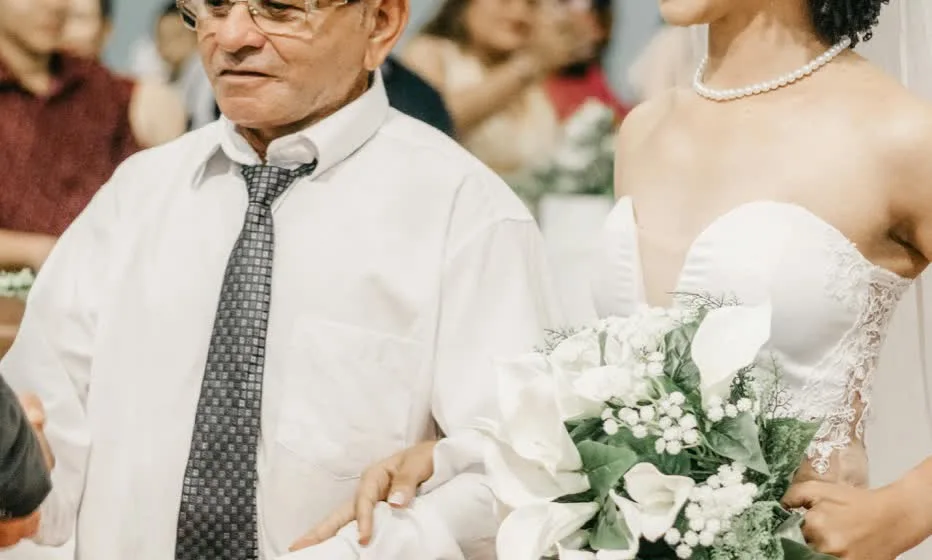
Father of Bride Speeches: 8 Examples That Hold the Room
Most father of bride speeches follow the same arc: thank the guests, say the bride looks beautiful, welcome the groom, deliver a joke from the internet, cry at the end. The room applauds because it's over. Nobody talks about it at brunch.
That's not what this page is for.
The father of the bride speech is the one moment at the entire wedding where you have the floor, the attention, and the credibility no one else in the room has. You've known her longer than anyone. You've watched her become the person standing there in a wedding dress. That's not a generic position — and the speeches that land, the ones people remember years later, are the ones that use it.
The problem with most example pages is the same problem as the speeches themselves: they trade in the general. The adjectives ("she's always been my little girl"), the chronological parade of memories, the groom welcome that sounds like reading from a card. None of it is wrong. None of it lands.
What actually transfers from a good example isn't the words — it's the architecture. The specific moment where the humor gives way to something honest. The turn that arrives naturally instead of being announced. The toast that closes something instead of just concluding.
This page gives you 8 real father of bride speech examples across different situations and tones, each with a breakdown of what it's actually doing. By the end, you'll understand the structure well enough to build your own version — with your own daughter, your own stories, and your own voice. At 130 words per minute, a 5-minute dad speech is 650 words. That's tighter than you think.
In this guide
Why most father of bride speech examples don't actually help
Father of bride speeches fail for the opposite reason of best man speeches. Best man speeches fail because the speaker is too nervous to be sincere. Dad speeches fail because the speaker is too sincere to be specific.
The emotional weight is real — sometimes overwhelming — and the response to that weight is to reach for the broadest, most encompassing language available. "She's been the light of my life." "Watching her grow into the woman she is today." "I couldn't be prouder." These sentences are true. They're also indistinguishable from every other father of the bride speech delivered in the last decade.
What the room is actually waiting for. Not the declaration — the evidence. Not "she's always been kind" but the specific moment when you saw that quality and it stopped you. The story from when she was nine. The thing she said to you in the car on the way to the venue. The moment that, when you describe it, makes her recognize herself.
One true story, told in enough detail that the room can see it, lands harder than ten minutes of general love. That's the architecture behind every father of bride speech that people still talk about years later. Look for it in the examples below — not the words, but the move underneath the words.
Photo: Luis Erives / Pexels
Father of bride speeches by situation
For your only daughter
"I've been preparing for today for a long time. Approximately thirty seconds after [daughter] was born, I started worrying about it. It turns out I was not worrying about the right things."
The story"When [daughter] was [age], she [specific, self-contained scene — something she did or said that reveals who she is now. The quality the room can see in her today]. I remember thinking at the time: whatever she's going to be, she's going to be exactly that. Not what anyone else expects. Exactly herself."
The turn"I spent years thinking the hardest part of today would be giving her away. That's not the right frame. You don't give people like [daughter] away. You just watch them choose — and feel grateful you had anything to do with who they became."
For the groom"[Groom], I've watched you with her for [time]. I know who she is at her best and her worst, and I've watched you choose both. That's what I needed to see."
Toast"To [daughter] and [groom] — may you always choose each other this clearly."
For your eldest daughter
"[Daughter] is our first. Which means she had to figure out how to be a person while we were still figuring out how to be parents. I'd like to take this opportunity to formally apologize for years one through six."
The story"What I remember about [daughter] growing up — the thing that was always true — is [specific quality, shown through a scene rather than stated as an adjective]. She was [age], and [specific moment]. I've never forgotten it."
The turn"She's been our test case for everything: for how to raise a person, for how to let one go, for what it looks like when you've done it right. Today I think we're seeing the answer. She's better than we had any right to expect."
Toast"To [daughter] and [groom] — and to whatever comes next for all of us."
For a stepdaughter
"When I met [daughter], she was [age]. She did not immediately decide I was her favorite person. That was fair."
How it actually happened"What I remember is [specific moment when something shifted — not a dramatic scene, but an honest one. The first time she called you something other than your name. The day she asked for your opinion about something that mattered. The small thing that told you she'd decided to let you in]."
The turn"I didn't get to be there for the beginning. But I've been here for [X] years, and I've watched her become someone I'm proud to stand next to today. I didn't earn the title of dad. I was just lucky enough that she gave it to me anyway."
Toast"To [daughter] and [groom] — I'm so glad I got this part of the story."
For the dad who doesn't give speeches
"I'm not a natural at this. [Daughter] knows that. I've said the wrong thing at the wrong time for most of her life. She's been patient with me."
The body — one story, nothing more"What I want to say tonight is [one thing — as specific as you can make it. The moment you saw who she was going to be. The conversation from last week. The thing you've meant to say for years and never found the occasion for]. I've been thinking about how to say it for a long time. This seemed like the right moment."
The turn"I'm not good at speeches. But I know my daughter. And watching her today, I don't think I've ever been prouder of anything."
Toast"To [daughter] and [groom]."

Photo: Engin Akyurt / Pexels
Father of bride speeches by tone
Funny father of the bride speech examples
"I've been working on this speech for six months. [Daughter] has asked me three times if I needed help writing it. That should give you some sense of how this is going to go."
The funny story (with a point)"When [daughter] was [age], she [specific, slightly absurd memory that reveals a character quality — her stubbornness, her loyalty, her particular version of being right about things]. I have thought about that moment many times in the years since. Mostly because she was correct, and I was not, and I've had to find a way to live with that."
The turn[After the humor] "Here's what I haven't said tonight, but should have, probably years ago: [one honest, specific thing about who she is or what she means to you]. Today seemed like the right time."
For the groom"[Groom], I'm going to keep this simple. Take care of her. She'll tell you she doesn't need it. She's wrong. Take care of her anyway."
Short father of the bride speech examples
"I'm going to keep this short, because [daughter] asked me to, and because everything I really want to say comes down to one thing anyway.
[Single specific story — 4–5 sentences. Self-contained. The moment that captures who she is better than any summary could.]
I've spent thirty years watching [daughter] become who she is. There were moments I was certain I was getting it wrong. There were moments she was generous enough to pretend otherwise. What I know for certain today is this: she turned out better than I had any right to expect, and I don't deserve full credit for any of it.
[Groom], I'm not going to give you the speech about taking care of her. You've seen who she is. You don't need that instruction. I'll just say: welcome to the family. We're glad you're here.
Please raise your glasses. To [daughter] and [groom] — may you choose each other every day the way you're choosing each other today."
Heartfelt father of the bride speech examples
"I've been thinking about what to say tonight for a long time. I'm going to try not to be too much."
The story (the engine of the whole speech)"[Specific moment — not the most dramatic one. The most honest one. The scene from when she was young that you've carried with you. The conversation you had recently that made you realize she's become a full person, separate from you. The thing she did that made you understand something about her you hadn't seen before.]"
The turn"I don't have a way to say what today means. I've looked for the words for months. What I can say is this: watching you become who you are has been the work I'm most proud of in my life — and most of it, if I'm honest, was you."
For the groom"[Groom], I have one thing to say to you, and I mean it plainly: she chose you. That means something. Don't forget it."
Toast"To [daughter] and [groom] — and to everything that comes next."
Simple father of the bride speech examples
"[Daughter] — I've been practicing this speech in the car for three weeks. I'm going to try to say it right.
[One story, plainly told. No flourish. The thing that explains who she is better than any description could.]
I'm not a man of many words. [Daughter] knows this. She's always said more than she needed to, and I've always said less. Today I'll try to meet somewhere in the middle.
I love you. I'm proud of you. And I think you chose well.
Please raise your glasses. To [daughter] and [groom]."
Photo: Pexels User / Pexels
The structure behind every father of the bride speech that works
Every example above — regardless of situation or tone — follows the same logic. Not a formula. A sequence of moves.
1. Open with something that earns attention. Not "Good evening, for those who don't know me, I'm [daughter]'s father." Not a thank-you list. Open with a story, a specific line, or a self-aware observation that immediately gives the room something to hold. The first thirty seconds are the highest-value real estate in the speech. Don't spend them on logistics.
2. One story. One. The instinct for every dad is to include everything — the childhood memory, the accomplishment he's proud of, the thing she said last week, the story the groom needs to hear. The speeches that land choose one and let it breathe. One specific, self-contained story told in 90 seconds reveals more about your daughter than ten memories listed efficiently.
3. The turn. This is the most important moment in a wedding speech for the father of the bride, and the one almost nobody plans for. It's the point where the humor or warmth gives way to the honest thing — not announced with "but in all seriousness," just arrived at naturally. The turn works when it feels like a consequence of the story, not a shift in gears. The room goes quiet in a way that's different from laughter.
4. One line for the groom — that's earned. Not a generic welcome. Something specific to what you've seen. What you observed in him. What gave you the evidence you needed. One honest sentence, not a paragraph of performed approval.
5. The toast. Two sentences. Specific. Raise your glass and let the room drink. Don't add more after the toast. The toast is the full stop.
The father of the bride speech outline that works isn't complicated — it just requires you to resist the pull toward comprehensiveness. Cover less. Land harder.
The opener that kills father of the bride speeches before they start
"Good evening, ladies and gentlemen. For those who don't know me, I'm [name], father of the beautiful bride."
This opener — or some variation of it — appears in the majority of dad speeches. The couple just introduced you. Every person in that room knows you're the father of the bride; it's printed in the program. Opening with it signals to the room that what follows will also be what they expect.
The thank-you trap. Closely related: the speech that begins with a list of people to thank. The caterers. The venue. Both families. The bride and groom for choosing each other. These acknowledgments are fine — they're just not an opener. They signal that you're filling time before getting to the part that matters, and the room adjusts its attention accordingly.
What to say instead. Drop into the story. Start later. Start in the middle of a memory, with a line your daughter once said, with an observation that's only available to someone who's known her for thirty years. Context will establish itself in the first sixty seconds without you having to announce it.
Openers to avoid:- "For those who don't know me, I'm [daughter]'s father..."
- "Good evening, ladies and gentlemen. What a beautiful day it's been..."
- "I'd like to start by thanking everyone for coming..."
- "I'm not really one for public speaking, so bear with me..."
- "I have so many things I want to say, I don't know where to start..."
None of these are wrong. They're just wasted seconds at the moment when the room is most willing to follow you. The first thirty seconds of the dad speech are when the room decides whether to lean in or settle back. Use them.
Write your father of the bride speech in minutes.
Tell us about your daughter — the stories, the moments, the things you've never quite found words for. We'll turn them into something specific, honest, and exactly right. Free preview — no card required.
Write My Father of the Bride Speech → Preview the opening for free · $34 to unlock the full speechFrequently asked questions
Stop reading examples. Write yours.
You have the material — thirty years of it. The speech you're worried about is going to be better than you think. Tell us the story only you know, and we'll help you build the rest.
Get My Father of the Bride Speech Written →