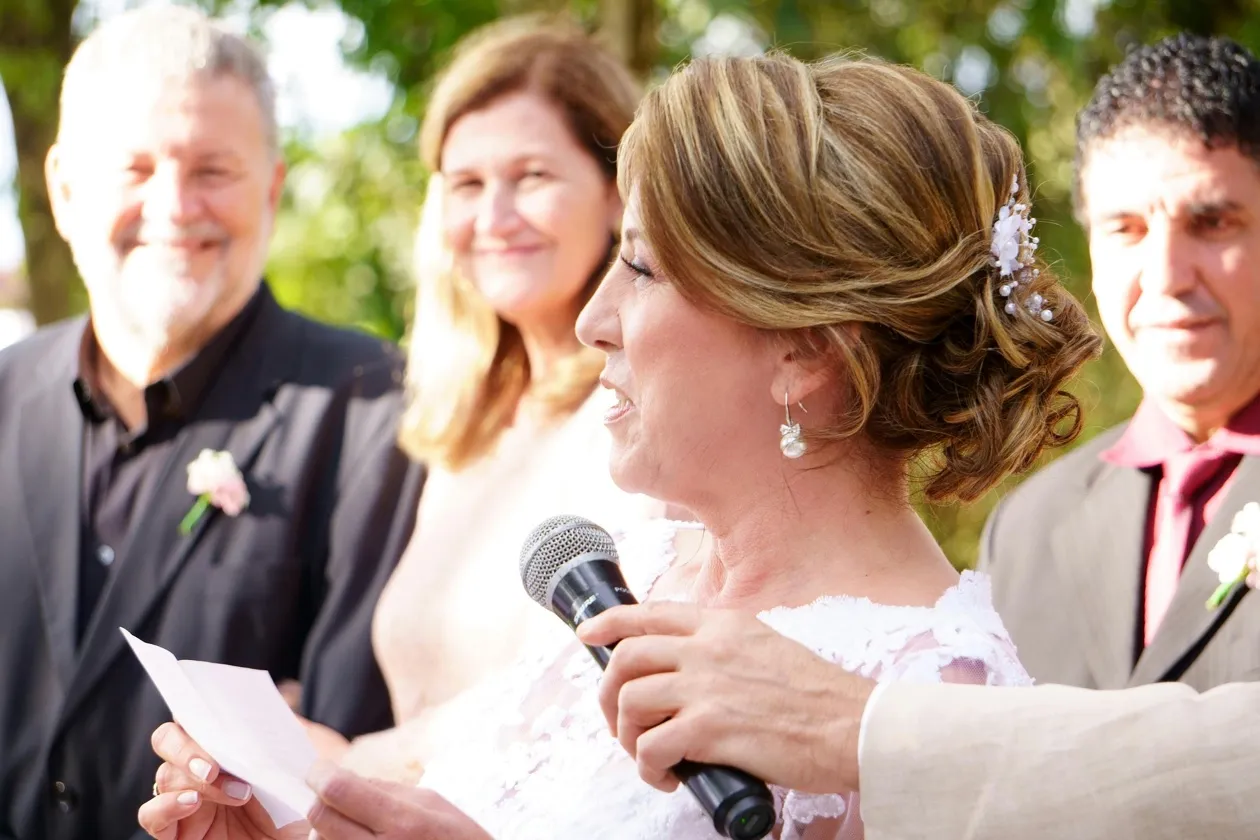
Maid of Honor Speech Examples: 8 That Actually Land
Most maid of honor speech examples you find online are generic enough to fit anyone. That's the problem. They read like they were written for a fictional bride by someone who's never met her — full of "she's been my best friend since..." and "I'm so happy to welcome [groom] to our family." Technically correct. Completely forgettable.
The speeches people remember — the ones that get talked about at brunch the next morning — are the ones where the room feels like they're hearing something real. Not a tribute. Not a toast template. A specific, honest account of who this person is and what this day means.
This page gives you 8 examples across different relationships and tones, each with a breakdown of what's actually working underneath the words. The goal isn't to hand you a script. It's to show you the architecture so you can build your own version with your own material.
At 130 words per minute, a 4-minute maid of honor speech is about 520 words. That's shorter than you think. Every sentence needs to earn its place.
In this guide
Why most maid of honor speech examples don't actually help
The MOH speech sits in an interesting position: it carries more emotional expectation than the best man speech, and less permission to be purely funny. The room is expecting warmth, honesty, maybe tears, maybe laughter — ideally both. That's a harder brief, and most example pages respond to it by becoming even more generic.
What you'll find in most MOH speech examples: a list of adjectives ("she's strong, kind, and the most loyal person I know"), a brief origin story for the friendship, a welcome to the groom, and a toast. That structure works in the way a beige cardigan works — inoffensive, unremarkable, forgotten by Tuesday.
What the room is actually waiting for. It's not the list of qualities. It's the story that proves them. Not "she's always been there for me" — but the specific moment when she was, told in enough detail that the room feels the truth of it. One story, specific enough that only you could tell it, honest enough that the bride recognizes herself in it.
That's the thing you're looking for in the examples below. Not the words — the structure underneath. Once you can see how the turn works and where the specificity lives, you can build your own version with your actual material.
Photo: BR1 FDS / Pexels
Maid of honor speech examples by relationship
For your best friend
"[Bride] and I became friends in [context — college, work, third grade]. I can say with complete confidence that she would have written a better speech for me. She's better at most things. That's part of why I love her."
The story"About three years ago, [specific moment — something she did that reveals who she is. Not the most dramatic thing. The most revealing thing. The version of her that only you would know.]"
The turn"I've known [bride] long enough to know when something is real for her. And I've watched her with [groom] for [X] years. This is the most real I've ever seen her. I'm not surprised — but I am so glad."
Toast"To [bride] and [groom] — may you always choose each other as easily as this."
For your sister
"Being asked to give this speech meant more than I expected it to. Partly because [bride] is my sister and today is enormous. Partly because I've been waiting years to have a microphone in front of her with no way to stop me."
The story"Growing up, [bride] was [honest, specific observation — not 'she was always there for me' but something you actually remember. A specific scene from childhood that the room can see]. I didn't understand then what I understand now: [what you understand now about that quality of hers]."
The turn"[Groom], I want to say something to you directly. My sister doesn't love easily. She takes a long time to trust people and an even longer time to let them in. Watching her with you — the way she laughs differently, the way she's become more herself, not less — I just want you to know: you did something. Don't take it lightly."
For a college friend
"[Bride] and I met [how] in college. We were twenty years old, we had very strong opinions about very unimportant things, and somehow, through that, we actually became real friends."
The storyAsk yourself: What's the story about her that doesn't need context to land? Not the inside joke. The moment that reveals her character in a way anyone in the room can recognize — the decision she made, how she handled something badly, how she handled it better, who she proved she was when it mattered.
The turn"I've watched [bride] become more herself over the [X] years I've known her. More confident, more honest, more the person I could already see at twenty. [Groom], you get the finished version. I promise she's worth the wait."
For a childhood friend
"[Bride] and I have been friends since we were [age]. That's [X] years of knowing her — which means I've watched her become this person from the very beginning, when she was [specific, slightly embarrassing or revealing detail about young her]."
The turn"The thing about knowing someone that long is that you see the through-line. The quality in her at [young age] that is still exactly the quality I see today. The difference is she's found someone who sees it too — and chooses it, every day. That's not something I take for granted on her behalf."
Toast"To [bride] — who has always been worth the toast. And to [groom], who finally made it official."
Photo: Walter Cordero / Pexels
Maid of honor speech examples by tone
Funny maid of honor speech examples
"[Bride] gave me three instructions for this speech: keep it short, don't cry, and don't say anything about [specific thing]. I'm going to try to honor at least two of those."
The funny storyThe best funny material in an MOH speech usually lives in the specific absurdity of the friendship — not a single punchline, but the kind of story that makes the room laugh because the detail is so precise it has to be true. "[Bride] is the person who [specific thing she does — a habit, a pattern, a decision she made that was so her]. I have watched her do this for [X] years and I have never once said anything because it's not my speech to give. It is now."
The turn[After the humor] "Here's what I haven't said. [One honest, genuine thing about who she is — the quality the funny material was pointing at all along]. I'm very glad she has [groom] to [see that / match that / deserve that]."
Short maid of honor speech examples
"I've been thinking about what to say tonight for longer than I'm comfortable admitting. Everything I wrote felt either too much or not enough.
What I landed on is this: [single specific story or observation about the bride — 4–5 sentences. Something only you could say. The thing that explains who she is to anyone in the room who doesn't know her well, and makes anyone who does know her nod.]
[Groom], I've watched [bride] for [X] years make very careful decisions about who she lets in. I want you to know what it means that you're here today. She chose you with her whole self. That doesn't happen by accident, and it doesn't happen lightly.
Please raise your glasses. To [bride] and [groom] — may you always look at each other the way you're looking at each other tonight."
Heartfelt maid of honor speech examples
"I'm not going to try to be funny tonight. That's not what I have to say."
The story"[Specific moment — something you witnessed that revealed who the bride is. Not the most dramatic thing. The most honest thing. The version of her that you carry with you as proof of who she actually is.]"
The declaration"[Bride], I've been trying to find the words for years for what you mean to me. I'm not going to find them tonight — but I want you to know that watching you today is one of the best things I've ever gotten to do."
Toast"To [bride] and [groom] — I'm so glad you found each other."
Maid of honor speech examples when you don't know the groom well
"I'll be transparent with you: I don't know [groom] as well as I know [bride]. But I know her. I know how she talks about people she loves. I know what she sounds like when something is real and when it isn't. And I've listened to her talk about [groom] for [X] years. That's its own kind of knowing."
What you've seen"What I've seen, in the time I've spent with them together: [one specific observation — how she is differently around him, something you noticed, a moment you witnessed]. I didn't need more than that."
Photo: Photography Maghradze PH / Pexels
The structure behind every maid of honor speech that works
Every example above — regardless of relationship or tone — follows the same logic. Not a formula. A sequence of moves.
1. Open with something that earns attention. Not "Hi, I'm [name], and I've been [bride]'s best friend since..." — the couple just introduced you. Open with a story, a specific line, a surprising observation. Use the first thirty seconds to hook the room, not fill them in.
2. One story. One. The instinct is to include everything — the trip you took, the night she called you crying, the thing she said when you met the groom for the first time. Choose one. The more specific and singular the story, the more it reveals. Three stories told efficiently feel like a list. One story told with room to breathe feels like truth.
3. The turn. This is the most important moment in the speech. It's where the humor or warmth gives way to genuine honesty — not announced ("but in all seriousness..."), just arrived at. The best turns feel like a natural consequence of the story. If you planned the turn, it probably sounds like you planned the turn. Find it in your material instead.
4. Something for the groom. Even one sentence. Even just an observation about who the bride is around him. It's the MOH's job to welcome him into the circle, not just celebrate the bride. One honest, specific thing is enough.
5. The toast. Two sentences. The speech is where you say everything. The toast is the seal. Raise your glass, say something real, let the room drink.
The speeches that fail usually fail at the turn — they stay in one emotional register the whole way through, or they announce the shift instead of earning it. Look at every example above: that's the architecture. The words are different. That's what you're building from, not the words.
The opener that kills maid of honor speeches
- "For those who don't know me, I'm [name], and I've been [bride]'s best friend since..."
- "[Bride] is honestly the most [adjective] person I've ever met."
- "When [bride] asked me to be her maid of honor, I was so honored and overwhelmed..."
- "I'm not really a public speaker, so bear with me..."
- "I have so many things I want to say, I don't even know where to start."
Write your maid of honor speech in minutes.
Tell us your stories. We'll build something specific, honest, and exactly right for tonight. Free preview — no card required.
Write My Maid of Honor Speech → Preview the opening for free · $34 to unlock the full speechFrequently asked questions
Stop reading examples. Write yours.
The speech you're worried about is probably going to be better than you think. Start with the one story only you could tell — we'll help you build it.
Get My Maid of Honor Speech Written →