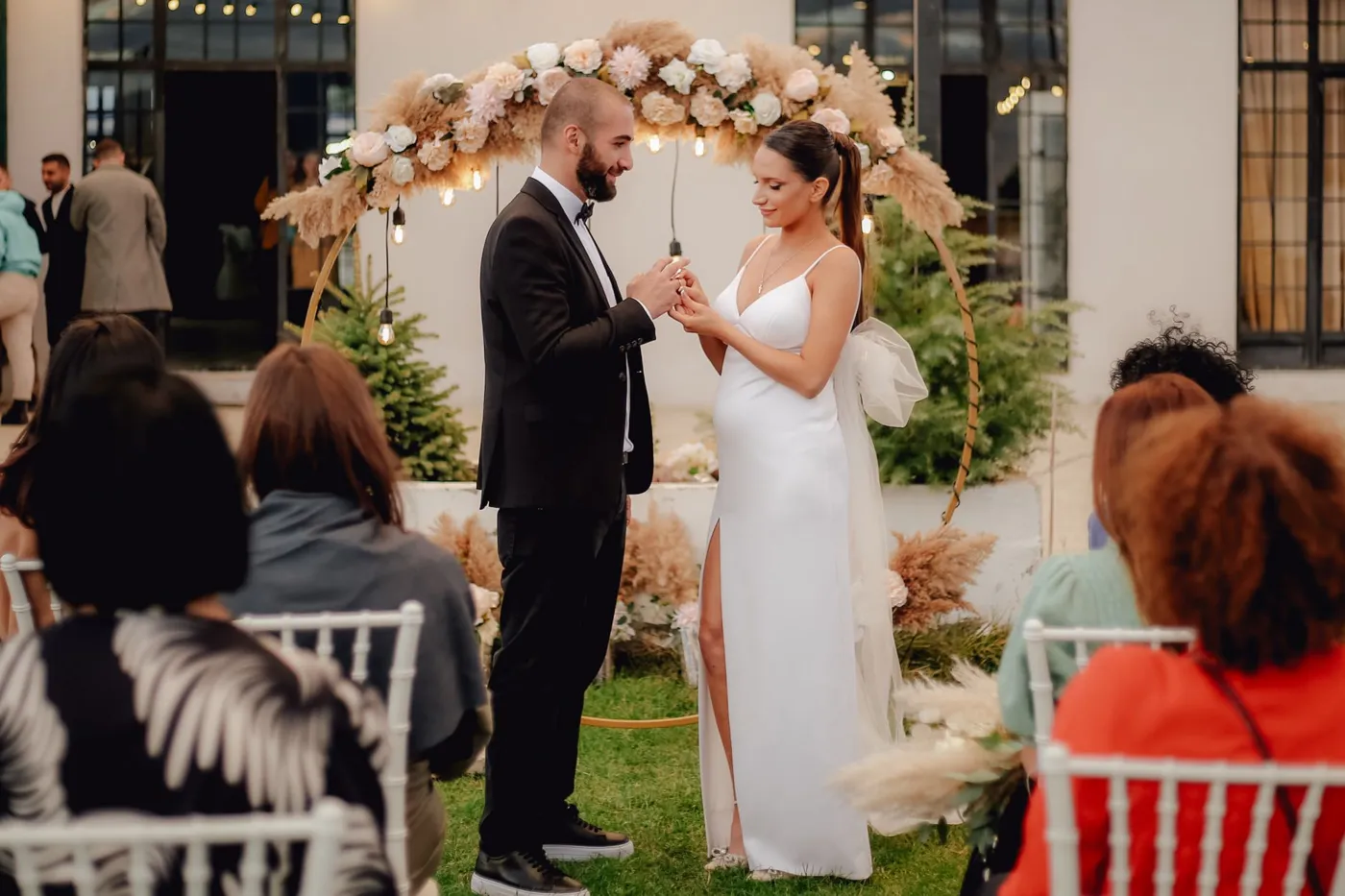
Marriage Vows for Wedding Ceremonies: Meaning, Templates and Ideas
Marriage vows for wedding ceremonies can be two sentences long or two minutes long, and nobody says you have to invent them from nothing. Most couples land somewhere in the middle: a few basic lines everyone recognizes, plus a promise or two that only apply to the two of them. If you've been searching for a wedding vow template at midnight, you're in good company.
This guide covers what wedding vows are, the basic wording you can use as is, a fill-in template, and plenty of vow ideas for him and for her. You'll find complete samples with a quick note on why each one works. If you want a bigger collection of finished samples, see our <a href="/blog/wedding-vows-examples">wedding vows examples</a>. For a slower, step-by-step process, there's our guide on <a href="/blog/how-to-write-wedding-vows">how to write wedding vows</a>.
One more thing before we start. Vows are the part of the wedding you should write yourself, because nobody else knows what you'd promise. But if you're also giving a speech at the reception, that's a different job, and it's one we can take off your plate. We'll write it from your own stories, so there's no blank page. More on that near the end.
In this guide
- What are wedding vows?
- Basic marriage vows for wedding ceremonies
- A wedding vow template you can fill in
- Wedding vow ideas when you're stuck
- Marriage vows for him and wedding vows for her
- Choosing the best marriage vows for wedding ceremonies
- After the vows comes the reception speech
- Last tips before you write
- FAQ

Photo: Kawê Rodrigues / Pexels
What are wedding vows?
Wedding vows are the promises you make to your partner during the ceremony, spoken out loud in front of your officiant and your guests. They're the moment most people picture when they think of two people getting married. The ring exchange, the kiss and the pronouncement all follow from them.
Vows come in two broad forms. Traditional vows use set wording handed down by a religious tradition or a civil ceremony, and your officiant usually has a version ready. Personal vows are written by you and say whatever you want to promise. Plenty of couples blend the two, using a short standard promise to make it official and a personal paragraph to make it theirs.
Most vows, whatever the style, include some mix of these pieces:
- An address. Your partner's name, so it's clear who you're talking to.
- A statement of choice. Something like "I take you" or "today I choose you."
- The promises. What you're committing to, from the big (faithfulness) to the small (always sharing the blanket).
- A closing line. Often a short phrase about time, like "from this day forward."
Vows aren't the same thing as a toast or reception speech. Vows are said to your partner, quietly, with the guests overhearing. A speech is said to the whole room, usually with a glass in someone's hand. Different audience, different tone, and we'll come back to that at the end.
Basic marriage vows for wedding ceremonies
If writing your own isn't for you, that's completely fine. Basic vows have been used for generations because they work. They're short, they sound right out loud, and nobody has to memorize anything. Here are three simple versions you can use as written or tweak with a single line of your own.
Basic vows you repeat after the officiant
This is the most common format. The officiant says a phrase, you repeat it, and the whole thing takes under a minute. It's a good fit if you get nervous in front of a crowd, because you never have to remember the next line.
I, [name], take you, [name], to be my spouse.
I promise to love you, to respect you, and to stay by your side.
In joy and in sorrow, in health and in sickness, I will be true to you for all the days of my life.
Why it works: The rhythm carries the moment. Everyone in the room recognizes the shape of it, and that familiarity feels like ceremony. If you want it to feel more like yours, add one sentence at the end, such as a promise only you two would understand.
Simple non-religious vows
If your ceremony is secular, you can keep the structure of traditional vows without the religious language. These read like plain, honest promises.
[Name], today I choose you. I promise to be honest with you, to back your dreams, and to make room for you in every plan I make. I promise to make our home a place where we can both exhale.
I'll love you on the easy days and the hard ones. This is my promise, and I'm so glad it's you.
Why it works: Every promise is something you could actually keep. Notice that none of them are dramatic. Calm, believable promises tend to move people more than grand ones.
Basic vows for the ring exchange
Some ceremonies save the vows for the rings, with one short line per person. It's tidy, and it keeps the ceremony moving.
[Name], I give you this ring as a sign of my love and my promise. Wear it as a reminder that you're never alone, and that I'm in this with you. With this ring, I marry you.
Why it works: It ties the words to a physical action, which makes the moment easy to remember. It's also short enough that you can say it from memory if you'd rather not hold a card.

Photo: Eugenia Remark / Pexels
A wedding vow template you can fill in
A good wedding vow template gives you structure without telling you what to feel. It's a marriage vows template with blanks, and the blanks are where the real writing happens. Here's a simple one that covers a minute or so when spoken out loud.
[Name], [one sentence about the moment you knew, or something you've noticed about them that most people miss].
Since then, [one sentence about what they've changed or given you].
So today I promise [a small everyday promise]. I promise [a promise for the hard days]. I promise [something silly or specific to the two of you].
[One sentence looking ahead: the home, the years, the thing you're excited about.]
I love you, [name]. [A short closing line.]
Here's the same wedding vow template filled in, so you can see how much of the work is just choosing true details.
[Name], I knew on our second date, when you stopped the car to move a turtle off the road and then apologized for making us late.
Since then, you've made me braver without ever pushing me.
So today I promise to cook dinner on the nights you're too tired to think about it. I promise to tell you when I'm scared instead of going quiet. I promise to keep saying yes to your terrible road trip ideas.
I can't wait to grow old with you, probably in a house full of mismatched mugs.
I love you, [name]. Let's keep going.
Why it works: The turtle story shows who your partner is without a single adjective. The promises move from practical to emotional to playful, and the ending is short. The whole thing runs about 100 words, so it's well inside the one to two minute range.
To use the template, follow this order:
- Fill in the memory first. It's the hardest blank, and the rest gets easier once it's done.
- Write three promises, then cut the weakest. If a promise sounds like it came from a greeting card, replace it.
- Say it out loud. Change anything you stumble over.
- Print it in a large font. Your hands will probably shake a little, and a big font helps.
Wedding vow ideas when you're stuck
Sometimes you don't need a template. You just need a way in. These wedding vow ideas are starting points. Pick the one that sounds most like the two of you and build from there.
- Build the vow around one object. A lamp, a car, a coffee maker, a hiking trail. Return to it three times and the vow ties itself together.
- Write a list of small promises. A string of "I promise" lines, each one more specific than the last, ending with one big one.
- Start with the first time you saw them. Not the first date, the first moment you noticed something.
- Answer something they once said. If they told you something on a hard day that stuck, let your vow respond to it.
- Name what they've taught you. Patience, laughing at yourself, how to ask for help.
- Include the family you're building. A pet, stepchildren, or a household full of plants all count.
- Say part of it in another language. One line in a language that matters to your family can be the most memorable moment of the ceremony.
- Promise something for the hard seasons. Everyone in the room has been through hard seasons, and they'll recognize it.
Here's what the "list of promises" idea looks like when it's done well.
[Name], I promise to always check the oven before we leave the house. I promise to say sorry first, at least some of the time. I promise to learn the names of your cousins, even the ones who talk during movies.
I promise to never let you carry the hard things alone. And I promise that whatever we're doing, I'd rather be doing it with you.
Why it works: The first three are light, which relaxes the room. The last two shift to something sincere, so the humor leads somewhere. If you're stuck, this structure is one of the easiest to write.
Marriage vows for him and wedding vows for her
People often search for marriage vows for him or wedding vows for her as though they're written differently. They're not. The structure is the same, and what changes is the detail. Here's one of each, so you can see how specific observations make the difference. The same approach works for any couple, whatever your gender.
Marriage vows for him
[Name], you're the steadiest person I know. When my job fell apart, you didn't give me a speech. You made dinner and asked what I needed. I've thought about that night a lot, because it's when I understood what it means to be on someone's team.
I promise to be on your team every day. I'll listen before I try to fix anything. I'll cheer louder for your wins than for mine. I'll let you pick the music on every road trip, mostly.
You're my best friend and my favorite place to be. I'm yours.
Why it works: The story shows his character instead of describing it. The promises answer the story directly, and the small joke before the ending keeps it warm.
Wedding vows for her
[Name], you laugh with your whole body, and I'd travel anywhere to hear it. You taught me that taking life seriously doesn't mean being serious all the time.
I promise to make you laugh on the days it's hard to. I promise to take your side, and then tell you the truth when you ask for it. I promise to remember you like the window seat, and to give it to you without a speech about how I like it too.
You're the best decision I've ever made. I can't wait for all of it.
Why it works: The opening line is a compliment you can picture. The window seat promise is the kind of detail that makes people in the room smile, because they know someone like that.
Choosing the best marriage vows for wedding ceremonies
The best wedding vows aren't the most poetic. They're the ones that sound like the person saying them. After reading hundreds of examples, a few patterns show up again and again.
- They're specific. A scene beats an adjective every time.
- They're short. One to two minutes, which is roughly 150 to 200 words. Shorter is fine.
- They're kept promises. Nothing you wouldn't actually do. "I'll never be angry" isn't believable, and everyone knows it.
- They end on something simple. A short line works better than a long finish.
And here's what to leave out:
- Inside jokes only two people get. One is fine. Five turns the room into an audience for a private conversation.
- Anything about exes or past relationships. Even in a positive way.
- Quotes that replace your own words. One short quote is okay, but don't let it carry the vow.
- Anything that'll embarrass them. Vows are the wrong place for roasting.
It also helps to agree on a rough length with your partner. You don't have to match word for word, but if one of you reads for three minutes and the other for thirty seconds, it can feel lopsided. Keep the content a surprise if you like, and just agree on the length.

Photo: Jay jay Redelinghuys / Pexels
After the vows comes the reception speech
Here's what a lot of people don't realize until the planning is well underway. Vows are only one of the two times you'll speak. If you're the bride or the groom, there's usually a reception speech too, where you thank the guests, mention the people who got you here, and say something about your new spouse in front of everyone.
Vows are quiet and direct. A reception speech is warmer and louder, and it has a different job. You're talking to parents, grandparents, friends from three different eras of your life, and a few people you've only met twice. That's a harder room to write for, and it's easy to end up with something generic.
That's where a personalized speech beats a template. A sample can give you a structure, but it can't know that your partner's grandmother taught you to make dumplings, or that your best friend drove six hours to be there. We ask about those things, then write the speech from your answers. You skip the blank page, and you end up with something that sounds like you. It takes a few minutes, not an evening.
If you'd like to see what finished speeches look like first, our wedding toast examples cover the tone and structure by role. Vows are yours to write. The speech is the part we can help with.
Last tips before you write
You don't need to be a writer to write good vows. You need three true things and a quiet half hour. Start by jotting down a memory, a promise and a hope for the future, then arrange them in whatever order feels right.
- Write it in the voice you use at home. If you'd never say it at the kitchen table, change it.
- Practice out loud at least three times. The first read will always feel strange.
- Bring a printed copy. Your phone is a bad place for something this important.
- Look up between sentences. Your partner is the one you're talking to.
- Ask your officiant for the timing. They'll tell you how long the ceremony can run and when you should start.
And if you get stuck at any point, go back to the template above. A simple structure and one real memory are usually enough to get moving again.
We'll write your bride or groom speech for you
Your vows are personal, so write those yourself. But the reception speech is a different job, and it's the one that tends to cause the most stress. Tell us about your partner and your people, and we'll write a personalized speech in minutes, with no blank page.
Write My Speech → Preview the opening for free · $34 to unlock the full speechFrequently asked questions
Vows done. Speech next.
You've got a plan for the ceremony. The reception speech is the other one people remember, and it's the one most grooms and brides dread. Tell us about your partner and your people, and we'll write yours, personalized, in minutes.
Write My Speech →