Basic Wedding Vows: A Simple Format, Examples and Promises to Borrow
Basic wedding vows get a bad reputation they don't deserve. Plenty of couples want something simple: a few honest sentences, a clear promise, and a ceremony that doesn't turn into a writing contest. If that's you, you're in good company, and you can absolutely do it well.
Basic doesn't have to mean generic. A plain vow with one true detail in it beats a flowery one every time. Below you'll find a simple format, four complete examples with notes on why they work, a list of promises to borrow, and quick ways to make the words sound like you.
If you'd rather start from a fill-in form, our <a href="/blog/wedding-vows-template">wedding vows template</a> does that. And if the ceremony feels manageable but the reception speech has you nervous, we'll get to that near the end.
In this guide
- What basic wedding vows actually include
- A simple wedding vow format you can follow
- Basic wedding vows examples you can use
- Wedding vow promises you can borrow
- How to make basic wedding vows feel personal
- When basic wedding vows are the right choice
- Keep the vows simple, then make the speech personal
- FAQ

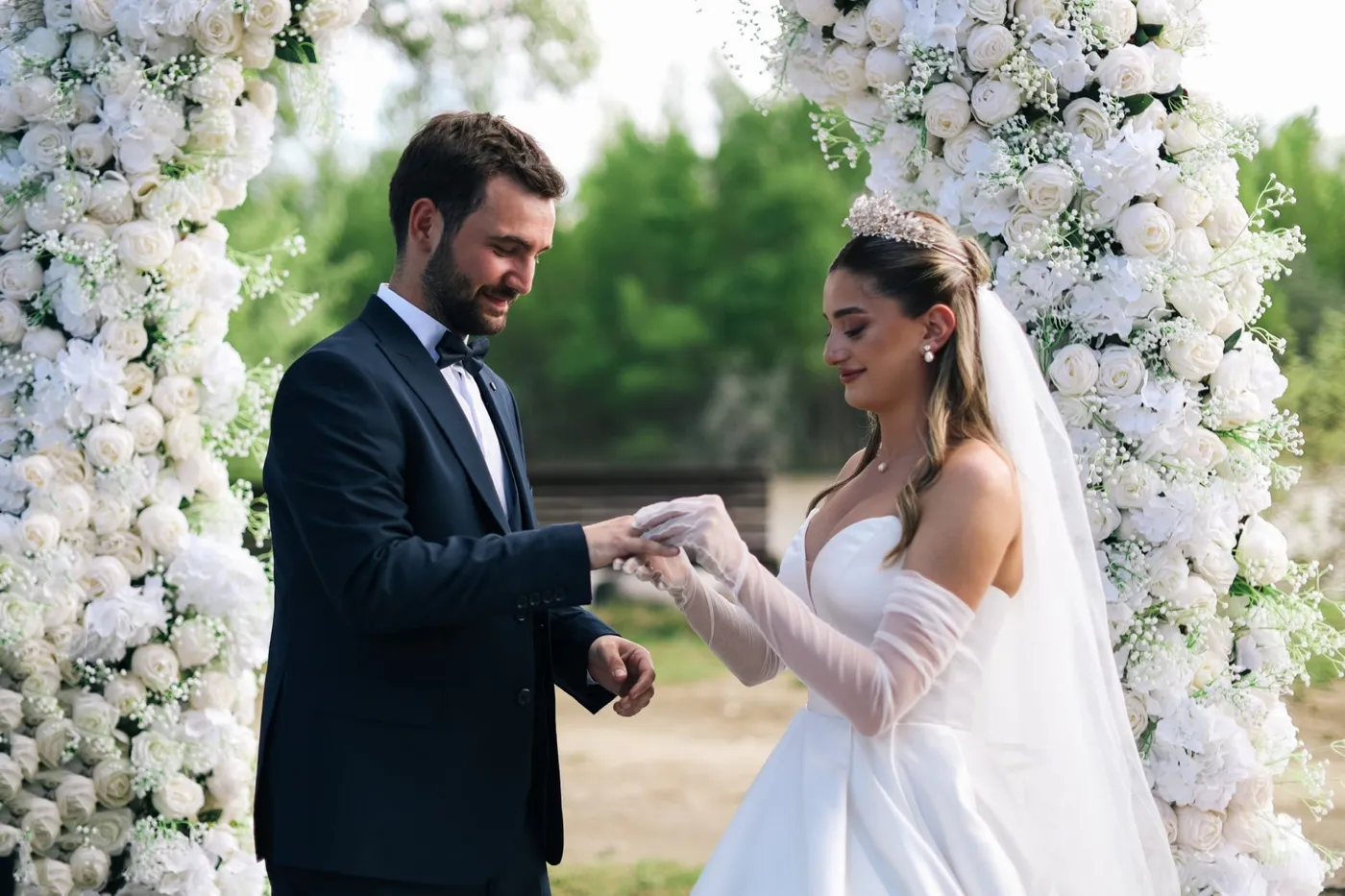
Photo: Luis Felipe Pérez / Pexels
What basic wedding vows actually include
Basic wedding vows are the plain, direct promises a couple makes to each other during the ceremony. There's no big story, no poetry, and no pressure to be clever. You say who you're talking to, say you love them, and make a few promises you actually intend to keep.
That simplicity is the whole point. A lot of couples feel stuck because they've watched a ceremony video that went viral and assume vows have to be a performance. They don't. Guests remember sincerity far more than polish, and a calm 45-second vow said with eye contact often lands harder than three minutes of nervous reading.
Most basic vows come in one of two forms:
- Officiant-led vows. The officiant says a line and you repeat it. Nothing to memorize, nothing to forget.
- Short written vows. You write three to six sentences yourself and read them from a card.
In either form, the same four things show up in nearly every set of wedding ceremony vows that works:
- Your partner's name
- A sentence about why you're marrying them
- Two to four promises
- A closing line that looks ahead
If you've got those four, you've got a complete vow. Everything else is decoration, and you're allowed to skip it.
A simple wedding vow format you can follow
If you're staring at a blank page, a wedding vow format takes most of the stress away. Here's an outline that fits almost any couple and is easy to adjust.
- Open with their name and a plain statement. "[Name], I'm so glad it's you." One sentence.
- Say why. One or two sentences about what you love in them or what changed when you met.
- Make your promises. Two to four, each starting with "I promise" or "I will."
- Look ahead. One line about the life you're building together.
- Close simply. "I love you" and their name is plenty.
At roughly 15 to 25 words per step, you land between 80 and 120 words, which is about 40 to 60 seconds out loud. If you want to check that against what's typical, our guide on how long vows should be covers timing in detail.
Agree on a shared format with your partner
You don't need to read the same words, but using the same wedding vows format helps the two sets feel balanced. If one of you reads five sentences and the other reads fifteen, it can feel lopsided even when nobody minds. Agree on a rough length, something like "about a minute each," and then write separately if you want to keep it a surprise.
Where the officiant fits in
Most ceremonies run in the same order. The officiant introduces the vows, the first partner speaks, the second partner speaks, and then you move into the ring exchange. Tell your officiant which version you're doing, especially if you want them to lead you line by line. Ask them to break each phrase into chunks of five to seven words so you can repeat them easily even when your heart is pounding.
Basic wedding vows examples you can use
Here are four complete examples, from the most minimal to the most personal. Use them as they are, or treat them as a frame and swap in your own details.
Example 1: Officiant-led vows, repeat after me
I, [name], take you, [name], to be my [husband/wife/spouse]. I promise to love you. To respect you. To stand by you. In good times and in hard times. From this day on. I give you my hand, my heart, and my love, for as long as we both shall live.
Why it works: The phrases are short, so they're easy to repeat even when you're nervous. There's nothing to memorize, and the rhythm gives the moment a sense of ceremony. If you want to make it yours, add one sentence at the end in your own words.
Example 2: Basic personal vows, about 90 words
[Name], I'm marrying you because you make me feel like myself. You're kind, you're steady, and you make me laugh when I'm trying to be serious.
I promise to be honest with you, to listen when it's hard, and to celebrate you out loud. I promise to keep choosing you on the busy days and the quiet ones.
I can't wait to build our life together. I love you.
Why it works: It follows the five-step outline exactly. The "why" is a feeling, not a list of adjectives, and the promises are things anyone could actually do on a Tuesday.
Example 3: Basic vows built on a list of promises
[Name], today I'm promising you a lot of small things, because small things are what a marriage is made of.
I promise to be your teammate. I promise to say sorry first when I'm wrong, and to say thank you more than I think I need to. I promise to keep our home a place where we can both rest. I promise to be patient with your bad days and proud of your good ones.
You've been my best friend since [year], and now you're my family. I'll love you through all of it. I love you.
Why it works: The opening line gives the list a reason to exist. Each promise is one sentence, so it's easy to read aloud, and you can swap any of them for something that fits your relationship better.
Example 4: Very short basic vows, about 35 words
[Name], I choose you. I promise to be kind, to be honest, and to be on your side. I'll love you in every season we get. You're my person, today and always.
Why it works: It keeps the shape of a longer vow and drops everything extra. This is a good fit if public speaking makes your hands shake, or if you want the ceremony to stay brisk.

Photo: RDNE Stock project / Pexels
Wedding vow promises you can borrow
Promises are the heart of any basic vow, and they're the easiest part to personalize. The best wedding vow promises are specific and realistic. Pick two to four that fit you instead of reading the whole list. Here are some to start with, grouped by what they cover.
Everyday promises
- I promise to listen, even when I'm tired.
- I promise to laugh with you every day, especially at myself.
- I promise to make time for us when life gets busy.
- I promise to say thank you for the small things.
- I promise to keep our home full of kindness.
Promises for the hard days
- I promise to tell you the truth, gently.
- I promise to say sorry first, and to mean it.
- I promise to stay in the conversation when it's uncomfortable.
- I promise to be on your side, even when we disagree.
- I promise to take care of you when you're sick, and to let you take care of me.
Promises that look ahead
- I promise to grow with you, and not mind who you become.
- I promise to keep being curious about you.
- I promise to build a home we're proud of, however long it takes.
- I promise to be your partner in every plan, including the ones we haven't made yet.
- I promise to love you more tomorrow than I do today.
Need a stronger first line to go with them? Take a look at how to start wedding vows for seven openers that lead naturally into promises like these.
How to make basic wedding vows feel personal
The fastest way to turn plain vows into personal wedding vows is to replace one or two generic lines with something only you could say. You don't need to write more. You just need to be more specific in a few places.
Here are some quick swaps:
- Generic: "I promise to always support you." Personal: "I promise to keep showing up at your 6 a.m. games and pretend I'm not freezing."
- Generic: "You make me so happy." Personal: "You're the only person who can make me laugh in a grocery store line."
- Generic: "I'll love you forever." Personal: "I'll love you through every move, every project, and every time we get lost on the way there."
If you're short on wedding vow ideas, answer these prompts in one sentence each and see what jumps out:
- When did you first know this was serious?
- What's the small thing they do that nobody else notices?
- What do they say or do when they're stressed, and how do you help?
- What's a phrase or joke only the two of you use?
- What's one thing you're looking forward to doing together?
Pick the one or two answers that make you smile, and drop them into your outline. That's it. You've gone from basic to yours without adding a single flourish. If you get stuck partway, our guide on help writing wedding vows has more ways to get moving again.
When basic wedding vows are the right choice
Simple vows aren't a fallback. For a lot of couples, they're the better choice. They tend to fit best when:
- You or your partner get anxious speaking in front of people.
- The ceremony is short, small, or held in a formal or religious setting.
- You'd rather save your longer stories for the reception.
- You're not sure what your partner will write and want a safe length to aim for.
Basic also leaves room for the moment itself. When the words are short, you can look at your partner instead of at the card, and that's the part people actually remember.
Common mistakes to avoid
- Copying a sample word for word. Guests can tell, and it usually doesn't feel like you. Use samples for structure only.
- Writing promises you won't keep. "I'll never get angry" isn't believable. "I'll talk to you before I go quiet" is.
- Leaning on inside jokes. One is fine. Five, and half the room feels left out.
- Skipping the read-aloud. A line that looks fine on paper can trip your tongue. Read it out loud twice and fix anything that sounds stiff.
- Forgetting the closing line. A vow that trails off feels unfinished. End on your partner's name or "I love you."

Photo: Jonathan Nenemann / Pexels
Keep the vows simple, then make the speech personal
Basic vows work because the ceremony is a private moment in a public setting. You're speaking to one person, and everyone else is just lucky to be there. A short, sincere promise is exactly right.
The reception speech is a different job. You're standing up with a microphone, talking to a whole room, thanking parents and guests, and telling stories about your partner that make people laugh and tear up. A generic template really does fall flat there, because the whole point is that it sounds like you and your story.
That's where we can help. If you're the groom or the bride and you're dreading the blank page, answer a few questions about your partner, your history, and the people in the room. We'll write a personalized speech from your own stories, with no staring at a cursor and no starting from a sample. It takes minutes, and you can preview the opening for free before deciding.
You should still write your own vows. They're yours to say. But the speech afterward doesn't have to eat up your weekend.
Let us write your groom or bride speech
Keep your vows short and personal. For the reception speech, tell us about your partner, your story and the people in the room, and we'll write a speech that sounds like you. No blank page, done in minutes.
Write My Speech → Preview the opening for free · $34 to unlock the full speechFrequently asked questions
Simple vows, personal speech
Your vows can stay short and sweet. The reception speech is the one that asks for stories, thank-yous and a few good laughs. Tell us about your partner and we'll write yours, personalized, in minutes.
Write My Speech →