Most people search for best man speech examples hoping to find something they can borrow whole. That's understandable. Wedding speeches are terrifying, the deadline is real, and a blank page at midnight four days before the wedding is nobody's idea of a good time.
The problem with most example pages is that they give you the words without the mechanics. You read the best man speech example, it sounds fine, you try to adapt it, and something doesn't translate. The tone feels off. The story doesn't land the same way. The room politely applauds.
What's missing is the why. An example is only useful if you understand what makes it work — the structure underneath, the specific moment the humor gives way to something honest, the reason the toast lands where it does. At 130 words per minute, a 5-minute speech is 650 words. That's shorter than you think when you're staring at a blank page.
This page gives you 8 real examples across different relationships and tones, with a breakdown of what each one is actually doing. By the end, you won't be copying words. You'll be building something that sounds like you.
TL;DR
A great best man speech needs one specific story that reveals something true about the groom, a genuine turn from humor to honesty, and a toast under two sentences. Length: 3–5 minutes. The rest is mechanics.
Why most best man speech examples don't actually help
The most common mistake with examples is treating them as templates. They're not. They're demonstrations — proof that a certain structure and tone can work. The specific words, delivered by someone else about someone they've known for twenty years, don't transfer to your situation.
What actually transfers is the architecture: where the opener lands, how the story is built, when the emotional register shifts, what the toast does. Once you can see that structure in an example, you can build your own version of it with your own material.
The "list speech" problem. Most online examples take a similar shape: here's how we met, here are three memories, here's a compliment about the bride, here's a toast. Technically correct. Emotionally weightless. The room applauds because it's over, not because anything landed.
The speeches people remember have a center of gravity — one specific moment or observation that everything else orbits around. That's what you're looking for in the examples below, not the words themselves.
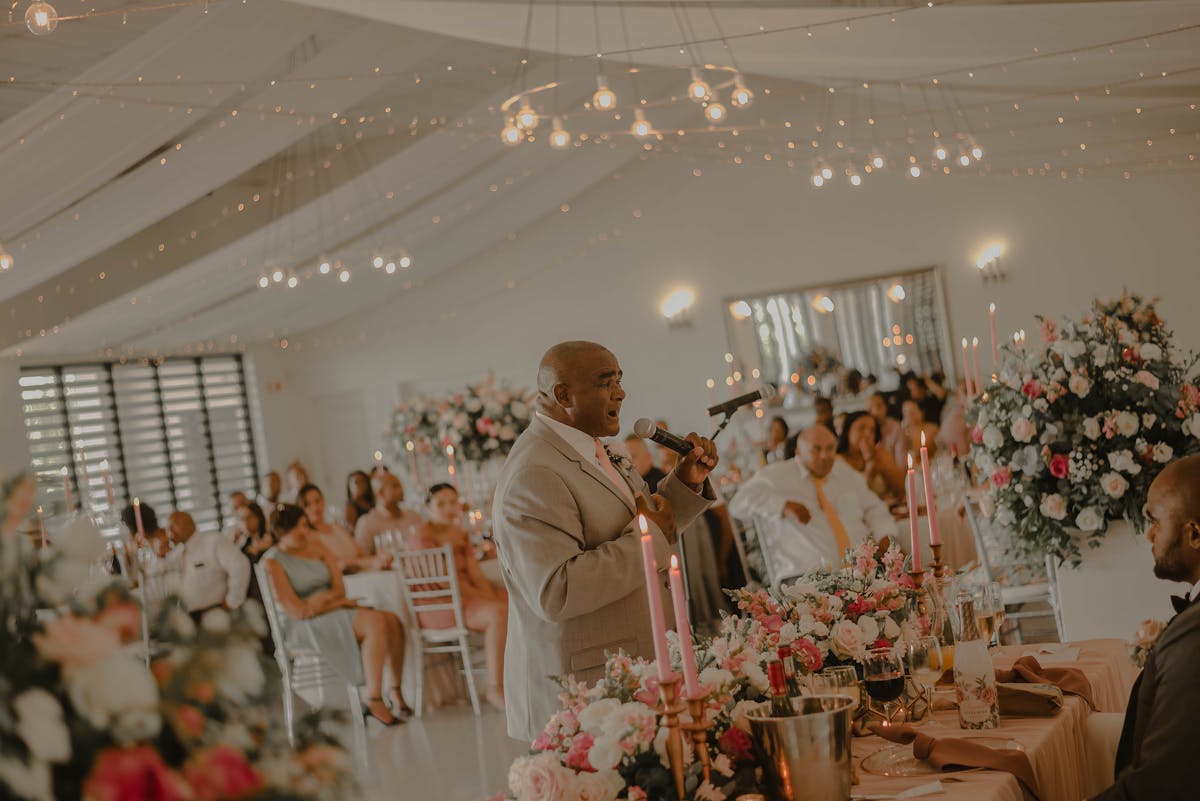
Photo: Evlogia Pictures / Pexels
Best man speech examples by relationship
The relationship you have with the groom shapes everything — the material you have, the expectations the room brings, and how much history you can invoke without explaining it. Here are four common situations and what works in each.
For your best friend
The best-friend speech carries the highest expectations in the room. Everyone assumes you have the material, which creates its own pressure. Use it.
Opening
"I've been [groom]'s best friend for fourteen years. In that time, I've watched him do a lot of things I was specifically asked not to mention tonight. He knows which ones. I know which ones. We'll leave it there."
The story
"About five years ago, [groom] drove three hours to help me move a sofa I'd bought off Facebook Marketplace. It was not a good sofa. He knew it wasn't a good sofa when I sent him the photo. He drove three hours anyway, said absolutely nothing about the sofa, and helped me carry it up four flights of stairs. That's the thing about him."
The turn
"I've spent a long time thinking about what to say tonight that isn't embarrassing or predictable. What I landed on is this: watching someone you love choose well is one of the better things you get to witness as a person. [Groom] chose well. I'm very glad to be here."
Toast
"To [groom] and [bride] — may your home always have room for questionable furniture, and people who'll help you move it."
Why this works: The opener acknowledges the implied subtext and immediately shows restraint — which builds trust with the room. The sofa story is specific, slightly absurd, and reveals a character quality without stating it directly. The turn arrives through the story, not in spite of it. The toast closes the callback without forcing it.
For your brother
Brothers tend to undercut the speech because they're nervous about being sincere in front of family. The version that works leans into the history without sentimentality — and earns the emotional landing by going through the comedy first.
Opening
"My brother asked me to give this speech. I agreed immediately, because for the first time in our lives, I get to talk about him for five uninterrupted minutes and he has to just sit there."
The story
"[Groom] was the kind of older brother who [specific memory — one small, revealing thing]. I spent years thinking that was just how he was. Then I met [bride], and I watched something shift in him. Not different. Just — better."
The turn
"I've been trying to figure out what to say tonight that isn't embarrassing and isn't boring. Here's what I landed on: [bride], you have no idea what you've done for this family. Thank you."
Toast
"To the two of you — and to whatever comes next."
The brother speech works best when it's plainly honest in the turn rather than reaching for poetry. The room knows the relationship. You don't need to explain it.
For a childhood friend
The challenge with childhood friendship is that your best shared material is twenty years old. The room doesn't share the context. The trick is picking the memory that's self-explanatory — the one that reveals his character without needing a paragraph of backstory.
Opening
"[Groom] and I have been friends since we were nine years old, which means I've known him for [X] years, and I've been trying to write this speech for approximately [X] of those years."
The story
Pick the memory that answers: who was he at his most himself? Not the funniest memory. The most revealing one. The moment that, when you describe it, makes the bride nod because she recognizes the person you're describing.
The turn
"The person I met at nine years old and the man standing here today are the same person. The same qualities. The same instincts. He just found someone worth showing them to more consistently."
For a college roommate or teammate
The room may not know the context for your friendship. One sentence of setup, then straight into the material — don't over-explain the relationship.
Opening
"[Groom] and I lived together for two years in college, which means I know things about him that are entirely irrelevant to this occasion, and I've made a promise to myself to remember that."
The pivot
"The version of [groom] I knew then was [honest, slightly self-deprecating observation]. The version standing here today is someone who [specific observable quality]. Whatever happened in the years between, [bride] deserves partial credit."
The college/teammate speech relies on the before-and-after structure — who he was when you met him, who he is now. It works when the contrast is genuine, not performed.
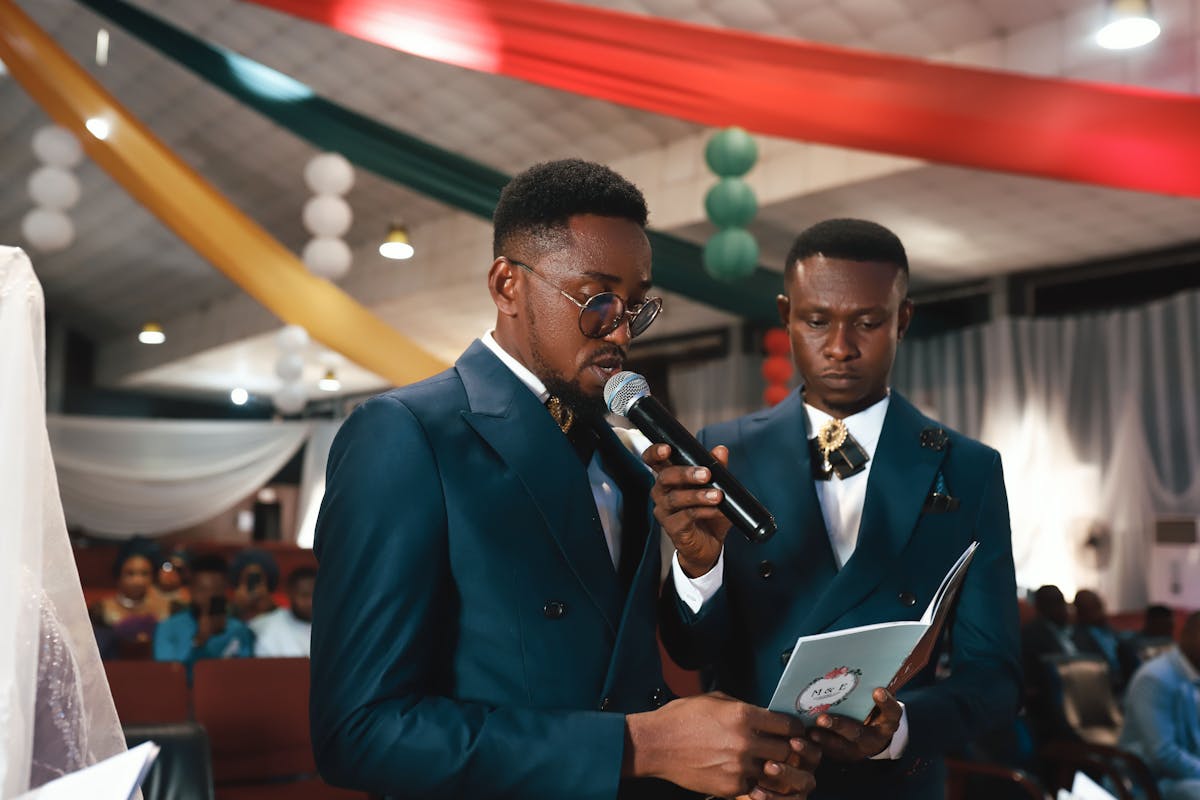
Photo: Engin Akyurt / Pexels
Best man speech examples by tone
Tone is less a choice you make at the start than something that emerges from your material. That said, some speeches lean harder in one direction. Here's what actually works in each mode.
Funny best man speech examples
Humor in a wedding speech isn't about jokes. It's about specific stories told the right way — and the willingness to let the punchline breathe instead of explaining it.
Funny opening that works
"I was asked to keep this under five minutes. Given that [groom] once spent forty-five minutes choosing a font for a birthday card, I consider that a reasonable constraint."
The funny-to-honest turn
[After the humorous section] "I've made fun of him for [thing]. What I haven't said — and should have, probably — is that [specific, genuine quality]. Tonight seems like the right time."
What funny best man speeches get wrong: They stay in comedy mode through the end and never let the room land somewhere real. The speeches that make people laugh and then go quiet are the ones people talk about the next day. The ones that only make people laugh are entertaining. The ones that only make people emotional are heavy. You want both, and the order matters: earn the trust with humor, then spend it on something honest.
Humor in a speech isn't about jokes. It's about specific stories told the right way — and the willingness to deploy them and then move on.
Short best man speech examples
A short best man speech — two to three minutes — is not a lesser speech. It's a more disciplined one. The constraint forces you to find the one story and tell it well, rather than padding with three stories told efficiently.
Full short speech (~280 words, ~2 min)
"I'm going to keep this short, because [groom] told me to, and for once in our friendship I'm going to listen to him.
[Single specific story — 3–4 sentences that reveal something true about him]
I've thought about what I wanted to say tonight, and I kept coming back to the same thing: I've known [groom] for [X] years, and I've never once seen him do anything halfway. Not work, not friendships, and — watching him this year — not this.
[Bride], I don't know what you see in him, but whatever it is, he's been trying to deserve it since the day you met. The rest of us are glad someone's holding him to a higher standard.
Please raise your glasses. To [groom] and [bride] — may you always choose each other."
At 130 words per minute, that speech runs just over two minutes. The room is still fully with you when the toast lands. That's the goal.
Heartfelt best man speech examples
Not every best man relationship runs on humor. If you're more naturally serious, or if your friendship is the kind that doesn't really have a comedy catalog, a sincere speech works — as long as the sincerity is specific and not general.
Generic sincerity sounds like: "He's the most loyal, kind, and generous person I know." Specific sincerity sounds like what's actually true about this particular person, in a moment you actually witnessed.
Heartfelt opening
"I'm not going to try to be funny tonight. That's not my strength, and more importantly, it's not really what I have to say about [groom]."
The story
"[A specific moment — not dramatic, but revealing. The thing he did when no one was watching. The way he handled something badly, then handled it better. The version of him that only a few people have seen.]"
The turn
"I've been trying to find words for this for months. What I keep coming back to is: I'm very glad you found each other. And I'm very glad I got to watch it."
Toast
"To [groom] and [bride] — may you keep choosing this."
What makes heartfelt speeches fail: They reach for emotion without earning it. The room feels the gap between what's being claimed ("he's the most incredible person") and what's been demonstrated. Earn the landing by showing something real first. The sincerity doesn't need to be announced — it arrives on its own when the story is specific enough.
Best man speech examples for non-public speakers
Most best men are not natural public speakers. The speeches that work in this situation aren't the ones that fake confidence — they're the ones that acknowledge the discomfort briefly and then move through it.
Opening that acknowledges nerves without dwelling on them
"I've rewritten this about twelve times, which [groom] will find either very touching or completely on-brand. I'm not sure which."
The body
Keep it to one story. One. The more stories you add, the more you have to hold in your head while nervous. A single specific story, told in 90 seconds, is better than three good ones told shakily.
The turn
"I'm not great at this. But I know [groom]. And watching him today, I don't think I've ever been prouder to be in a room."
Toast
"To [groom] and [bride]."
The non-public-speaker speech is almost always better when it's shorter. You're not trying to be memorable for five minutes — you're trying to say one true thing and sit down. That's enough. More best man speeches are ruined by going long than by going short.
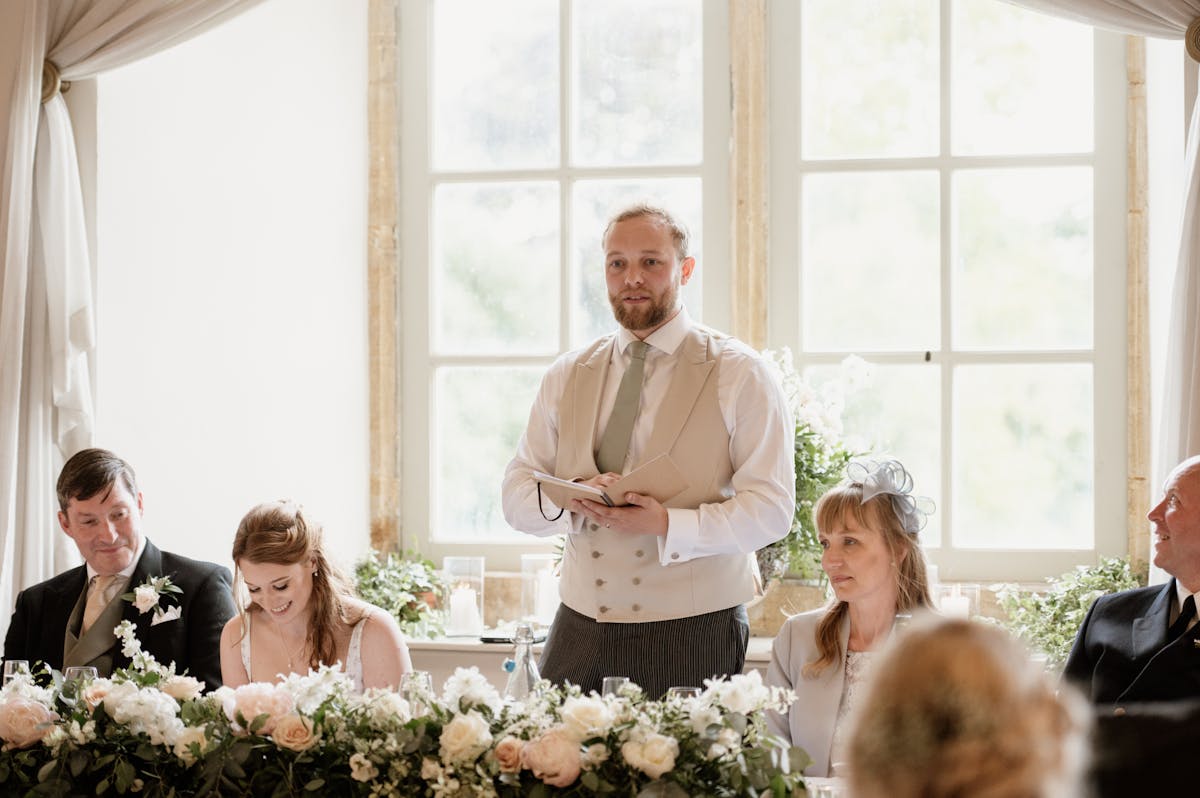
Photo: Pexels User / Pexels
The structure behind every example that works
Every example above — regardless of relationship or tone — follows the same underlying structure. Not a formula. A logic.
1. Open with something that earns attention — not your name and your relationship to the groom. The couple just introduced you. Use the first thirty seconds to hook the room, not fill them in.
2. One story. One. Not three good stories told efficiently. One great story told with room to breathe. The story should be specific enough that only you could tell it, and revealing enough that it shows who he actually is — not who he is in general.
3. The turn. This is the most important moment in the speech and the one almost nobody plans for. It's the point where the humor gives way to something honest — not announced ("but in all seriousness..."), just arrived at. The best turns feel like a natural consequence of the story. The room goes quiet in a way that feels different from laughter.
4. The toast. Two sentences. The speech is where you say everything. The toast is the seal. Raise your glass, say something specific and genuine, let the room drink.
The speeches that fail almost always fail at the turn — they stay in one emotional mode the whole way through, or they announce the shift instead of earning it. Look back at every example above: the structure is the same. The words are different. That's what you're adapting, not the words.
The one opener that kills a speech before it starts
"For those who don't know me" is the worst opener in wedding speeches — and it appears in roughly 40% of them.
The couple just introduced you. Everyone in that room knows who you are. Opening with it signals two things: you're nervous, and you haven't thought hard enough about the first thirty seconds. The room's attention peaks the moment you're announced. Using it to introduce yourself is the equivalent of a comedian walking onstage and asking if everyone can hear the microphone.
The alternative isn't clever. It's just to start. Drop into the story or the observation or the line. Context will emerge naturally in the first sixty seconds without you having to announce it.
What to avoid in the opening thirty seconds:
"For those who don't know me, I'm [name], and I've known [groom] for..."
"I'm not really one for speeches, but..."
"So I was asked to give this speech, and I've been writing it for weeks..."
"First of all, can everyone hear me okay?"
None of these are wrong. They're just wasted seconds. The room is with you from the moment you stand up. Don't spend that attention on logistics.
Skip the examples
Write your best man speech in 60 seconds.
Tell us your stories. We'll turn them into something specific, funny, and exactly right. Free preview — no card required.
3–5 minutes is the standard — roughly 400–650 words at a normal speaking pace of 130 words per minute. Most great best man speeches land at around 4 minutes. Going over 5 minutes is almost never worth it. The room's attention doesn't grow with the speech; it contracts. If you have a tight 3-minute speech, give the tight 3-minute speech.
Don't start with your name or how you know the groom — the couple just introduced you. Start with a story, a specific observation, or a line that immediately gives the room something to hold onto. The first thirty seconds are disproportionately important. Use them to earn attention, not fill in background.
The speech ends with the turn — the honest, genuine thing you actually wanted to say. The toast follows: two sentences, specific, raise your glass. 'To [names] — [one real wish]. Please raise your glasses.' That's the structure. Don't add more after the toast. The toast is the full stop.
Write the full speech out. Read it aloud repeatedly until you know it well enough to look up at key moments without losing your place. Reading from your phone is completely fine — it doesn't shake, doesn't lose your page, and doesn't run out. The idea that you should memorize it or use index cards is a myth. Use whatever lets you focus on delivery rather than logistics.
Find the story that's naturally funny because it's specific and slightly absurd — not because it's trying to be a joke. The funniest moments in real speeches are almost always specific details (the exact wrong thing he said, the exactly wrong time something happened) rather than constructed punchlines. Set it up, land it, move on. Don't explain the joke. Don't apologize for it. If the story is funny, it'll land.
Anything involving exes, anything that requires context most of the room doesn't have, anything that could embarrass the bride's family, and anything that goes over seven minutes. Beyond those hard limits: avoid generic adjectives ('he's kind, funny, and thoughtful'), avoid stories that require twenty seconds of explanation before they get interesting, and avoid the opener 'for those who don't know me.'
Stop reading examples. Write yours.
The speech you're worried about is probably going to be better than you think. Start with the one story only you could tell — we'll help you build the rest.