How to Write Vows Groom Guide: Steps, Structure and Examples
If you've typed "how to write vows groom" into a search bar, chances are the ceremony is on the calendar and your notes app is empty. That's completely normal. Most grooms haven't written anything this personal since a school essay, and nobody hands you a practice round.
Here's the good news. Groom vows aren't about being a writer. They're about saying a few true things to one person, out loud, in under two minutes. A guy who says "you make me laugh every day and I'm never getting tired of it" in his own voice beats a polished poem he found online.
This guide covers how to write your own vows from scratch, a simple structure to follow, four complete examples with notes on why they work, and the mistakes grooms make most. If you get stuck partway, our post on <a href="/blog/help-writing-wedding-vows">help writing wedding vows</a> is a good backup. And since you'll probably owe the room a reception speech too, we'll talk about that at the end.
In this guide
- What groom vows are (and how they differ from your speech)
- How to write vows as a groom, step by step
- How to write good vows that sound like you
- Groom marriage vows examples to learn from
- Mistakes to avoid when writing your marriage vows
- Length, practice and delivery
- Vows are yours to write. The reception speech doesn't have to be.
- FAQ
What groom vows are (and how they differ from your speech)
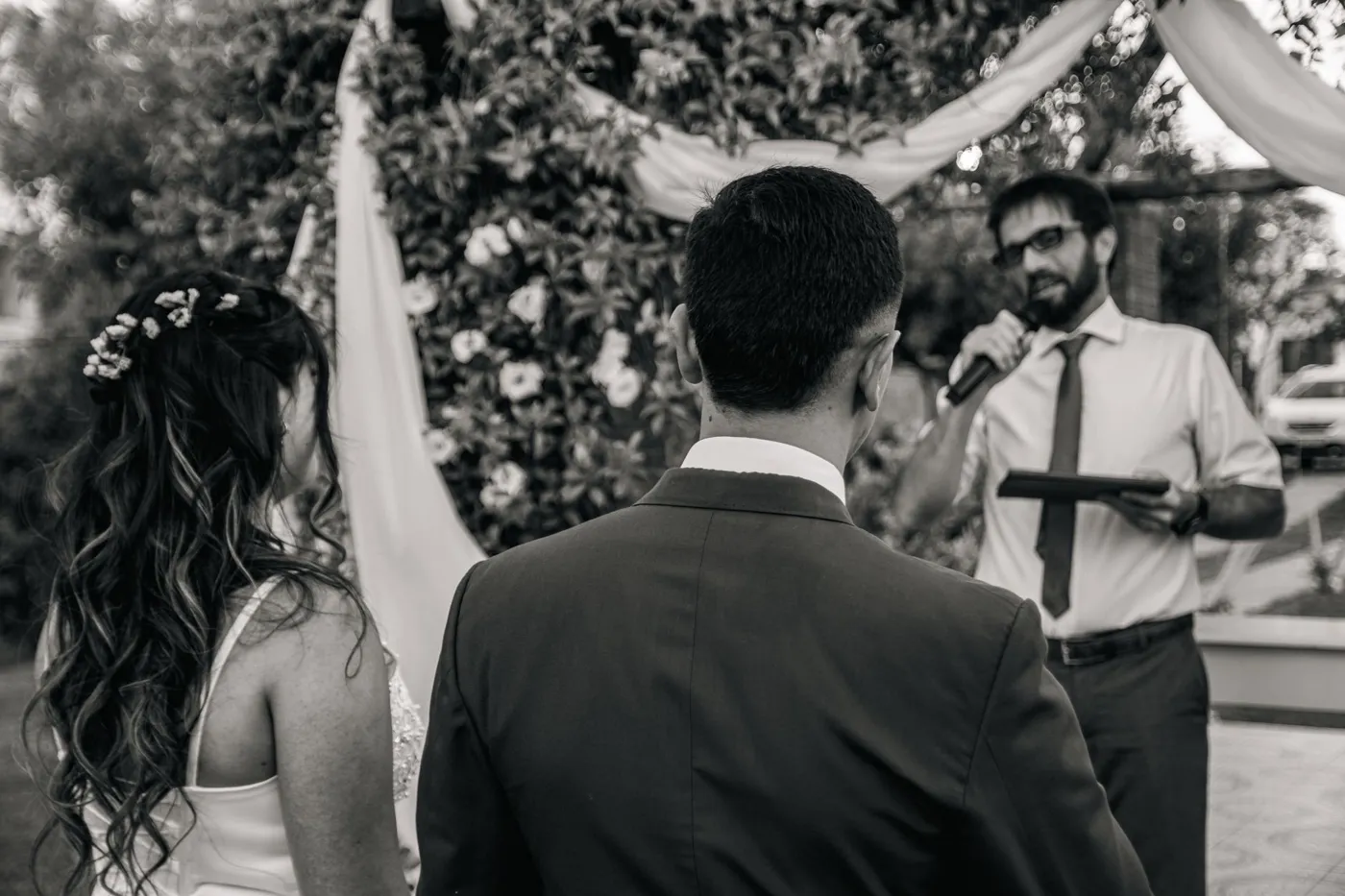
Groom vows are the promises you say to your partner during the ceremony, usually after the officiant's opening words and before the rings. They're not the same thing as the toast you give at the reception. Vows are spoken to one person. The speech is spoken to the whole room.
That difference changes how you write. In your vows you say "you" and "I," and you can be as private as you like. Guests are listening, but you're not performing for them.
Groom marriage vows usually come in two forms. Traditional vows are a set script, supplied by your officiant or your faith tradition. Personal vows are the ones you write yourself. Plenty of grooms do both: they repeat the traditional promise, then add a short personal vow. Ask your officiant early what's allowed, how long they'd like each person to go, and whether they need a copy ahead of time.
The process also doesn't change based on who you're marrying. How to write vows for her and how to write vows for him come down to the same steps below. Only the stories are different.

Photo: amine photographe / Pexels
How to write vows as a groom, step by step
If you want to know how to write your own vows without spending a month on them, follow these six steps in order. Most grooms can finish a solid draft in a couple of evenings.
Step 1: Set the ground rules
Before you write a word, settle three things. First, how long each of you will speak. Matching roughly is kind, since one person going three minutes and the other going thirty seconds feels lopsided. Second, the tone: sentimental, funny, or a mix. Third, whether you'll share your vows ahead of time or keep them a surprise. Neither choice is wrong, but decide together so nobody's caught off guard.
Step 2: Collect memories before you write
Don't open with a blank page and try to sound profound. Spend ten minutes making a messy list instead. Write down the first time you noticed something about them, a day they took care of you, an inside joke, a habit of theirs that you love and they don't know you notice, and a moment you pictured your future together. Scroll through old texts and photos if it helps. You won't use all of it. You're hunting for the two or three details that nobody else could have written.
Step 3: Pick the moment you knew
Every strong set of vows has one scene at its center. It could be a drive, a bad night, a small kindness, a trip that went wrong. Choose the memory that makes you feel something when you think about it, and describe it in two or three plain sentences. Say what happened, then say what it showed you about them. That's the heart of the vow, and everything else hangs off it.
Step 4: Write promises you can keep
Aim for three to five promises. The best ones are specific and slightly ordinary: "I'll tell you when I'm upset instead of going quiet," "I'll take the early shift with the baby," "I'll always laugh at your terrible puns, at least the first time." Skip promises nobody can keep, like "I'll never make you cry." A mix of serious and light works well, because it sounds like a real person made them.
Step 5: Finish with a look ahead
End by pointing forward. One or two sentences about the life you're building, then a short closing line. "I don't know everything that's coming, but I want to find out with you" is plenty. Don't trail off or add another story. When you've said the last line, stop and let the moment land.
Step 6: Cut, read aloud, repeat
Read the draft out loud and time it. Anywhere you stumble, rewrite it the way you'd say it to them across the kitchen table. Cut any line that could be said about anyone, like "you're my best friend and my rock." If you'd find it on a greeting card, swap it for something only you could say. For a deeper walkthrough, our guide on how to write wedding vows that sound like you has a fill-in template.
How to write good vows that sound like you
Once you've got the structure, voice is what separates good vows from forgettable ones. You're not trying to sound like a poet. You're trying to sound like you on your best, most honest day.
Write the way you talk. If you'd never say "my eternal companion," don't write it. Short sentences are fine. A sentence fragment is fine. Read each line out loud, and if it feels like wearing a costume, change it.
Choose specific over big. "You make me happy" tells your partner nothing new. "You hum when you cook and you don't know you're doing it" tells them you've been paying attention, and that's what they'll remember.
Keep humor to one or two light moments, and make sure the joke is something your partner would laugh at, not something that embarrasses them in front of their grandparents. Then finish sincere.
If you can't get started, borrow an opening line and finish it with your own details:
- "The moment I knew was..."
- "You have this habit of... and I hope you never stop."
- "Before you, I thought..."
- "Everyone here knows you as..., but I get to know you as..."
- "I used to think love was... Now I know it's..."
You'll delete the opener once the rest is written, and that's fine. It's just a way into the draft.

Photo: Lívia Bittencourt / Pexels
Groom marriage vows examples to learn from
Here are four complete examples with [name] placeholders. Don't read them word for word. Look at the structure, then fill it with your own memories.
Example 1: Sincere and personal
[Name], the first time I realized I was in trouble was in your car, in a parking lot, when you let me finish a story I was telling badly. You didn't interrupt. You just listened like it mattered. Nobody had done that for me before.
Today I promise to keep listening like that. I promise to say what I'm feeling before it turns into a silence. I promise to take your side, and to tell you kindly when I think you're wrong. I promise to keep showing up for the boring stuff, the dishes and the dentist appointments and the long drives, because that's where most of a life happens.
I don't know what's coming. I know I want you next to me for all of it. I love you.
Why it works: It opens with a real scene, not an adjective. The promises are ordinary and believable, and the ending is short and forward-looking.
Example 2: Light and funny, with a real ending
[Name], I promise to put my socks in the hamper, or at least in the same room as the hamper. I promise to stop saying "I'm not hungry" and then eating half your fries. I promise to let you pick the music on road trips, even though your taste is, let's say, brave.
Here's the serious part. You make me a better man without ever trying to change me. You're the first person I want to tell everything to, good news or bad. I'll keep choosing you in every apartment, every argument and every ordinary Tuesday.
I love you, [name]. Let's do this.
Why it works: The jokes are affectionate and built on real habits. The turn at "here's the serious part" lets the room go from laughing to feeling something in a single sentence.
Example 3: Short and traditional, about 60 words
[Name], I take you as my wife. I promise to be honest with you, to be gentle when it counts, and to stay when it's hard. I promise to build a home with you that we're both glad to walk into. You're my best friend and my favorite person. I'm yours, from today on.
Why it works: It keeps the formal rhythm of a traditional vow but adds two phrases that sound like him. If you're nervous about speaking in front of people, this length is perfectly fine.
Example 4: Vows for him (a groom marrying a groom)
[Name], when I met you, I wasn't looking for anything. You were the guy who stayed after the party to stack chairs and somehow knew everyone's name by the end of the night. I fell for that kindness first, and I've watched it show up every day since.
I promise to be as generous with you as you are with everyone else. I promise to cook dinner more than twice a month. I promise to hold your hand in airports, in waiting rooms and on the couch.
You've given me a family I chose. I'll spend my life taking care of it. I love you.
Why it works: The opening detail proves he's been paying attention. The promises are concrete, and the final lines tie them back to the home you're building together.
Mistakes to avoid when writing your marriage vows
Most vow problems come from a few predictable habits. If you can dodge these, you're already ahead of most people at the altar.
- Waiting until the night before. Vows written at midnight sound like it. Give yourself a week, even if you only work on them in short bursts.
- Quoting a movie or song for the whole thing. One line borrowed is fine. A vow made entirely of someone else's words isn't yours.
- Inside jokes nobody else gets. Your partner should laugh. The guests should at least understand why it's funny.
- Going on too long. A vow that runs five minutes loses the room, and loses the emotion with it.
- Talking about yourself. A few lines about who you were before are fine, but the vow is about them and about the promises you're making.
- Overpromising. "I'll never get angry" isn't believable. "I'll never go to bed angry without telling you why" is.
- Reading too fast. Nerves speed everyone up. Slow down more than feels natural.
Length, practice and delivery
Most groom vows land best between 150 and 200 words, which is about one to two minutes at a calm speaking pace. If you want the full breakdown, we put together a guide on how long vows should be, including shorter options.
Print your vows in a large font, or write them on a card you can hold steady. Phone screens get glare and shaky thumbs. Practice at least five times out loud, ideally standing up, and once in front of a friend who'll give you honest feedback.
On the day, take a breath before you start. Look at your partner, not the page, for the first line and the last. Pauses feel much longer to you than they do to anyone else, so let them happen. If your voice cracks, that's fine. Nobody in the room is grading you, and the cracks are usually what people remember best.

Photo: Juan Moccagatta / Pexels
Vows are yours to write. The reception speech doesn't have to be.
Your vows should come from you. Nobody else can say what only you know, and no tool should write them for you. But most grooms have a second job: the reception speech, where you thank the guests, honor your families and say something about your partner in front of everyone. That one can feel just as heavy, and it's much longer.
This is where a personalized, written-for-you speech helps. A generic example gives you structure, but you still have to find the stories, fit them in, and make it sound like you. With our groom speech writer, you answer a few questions about your partner, your families and the day, and we write a speech built from your own details. No blank page, and it's done in minutes. You can preview the opening for free before you decide.
Plenty of grooms write their vows over a few evenings and then run out of steam before the speech. If that sounds like you, hand off the speech and keep your energy for the words only you can say at the altar.
We'll write your groom's speech for you
Your vows should be yours. But the reception speech, where you thank everyone and talk about your partner in front of the whole room, is a different job. Tell us about your partner and your families, and we'll write a personalized groom's speech in minutes.
Write My Groom Speech → Preview the opening for free · $34 to unlock the full speechFrequently asked questions
Vows handled. Speech next.
You've got a plan for the words you'll say at the altar. The reception speech is the other one everyone remembers, and the one most grooms put off. Tell us about your partner and we'll write yours, personalized, in minutes.
Write My Groom Speech →