Mother of the Bride Speech: Examples, Structure & What to Say
The mother of the bride speech is different from every other speech at the wedding. It doesn't have the peer-to-peer warmth of the maid of honor speech. It doesn't have the proud-from-a-distance quality of the father of the bride speech. The mother of the bride has something no one else in that room has: a front-row seat to who this person became.
You didn't just know her — you raised her. You were there for the awkward years, the difficult years, the years she was figuring out who she was. You watched her become herself. And now you're watching her choose a partner, start a new family, and take a step that means the relationship you've had your whole lives is shifting into something new.
That's a lot to hold in a speech. The ones that work don't try to cover all of it. They find the one true thing — the specific story, the honest observation, the thing only a mother could say — and they build from there.
This page has mother of the bride speech examples across different relationships and tones, with a breakdown of what's making each one work. It also covers the structure behind every strong mother of the bride wedding speech, and the mistakes that quietly sink most of them.
In this guide
Why the mother of the bride speech carries more weight than any other
Every parent speech at a wedding carries a particular emotional authority. But the mother of the bride speech has a specific gravity that's hard to articulate and immediately felt by the room.
The father of the bride speech is often about pride — the public acknowledgment of what his daughter means to him. The maid of honor speech is about friendship. But the mother of the bride speech is about something harder to name: the experience of raising someone, watching them find their footing, and now watching them take a step that is entirely theirs.
What the room is actually listening for. They're not waiting for a list of qualities. They're not waiting for childhood stories, though one good one can be powerful. They're waiting for the thing that comes from twenty or thirty years of knowing someone: the observation that only a mother could make. The thing about who she really is — not the version she presents to the world, but the version you raised.
That's the material. Everything else — the humor, the welcome to the groom, the toast — is structure built around that core.
The speeches that fall flat do so because they try to cover too much: the childhood years, the teenage years, the relationship with the groom, a message to the couple, a list of hopes and wishes. What they're missing is the center — the one true, specific, honest thing that only the bride's mother could say. Find that first. Build outward from there.

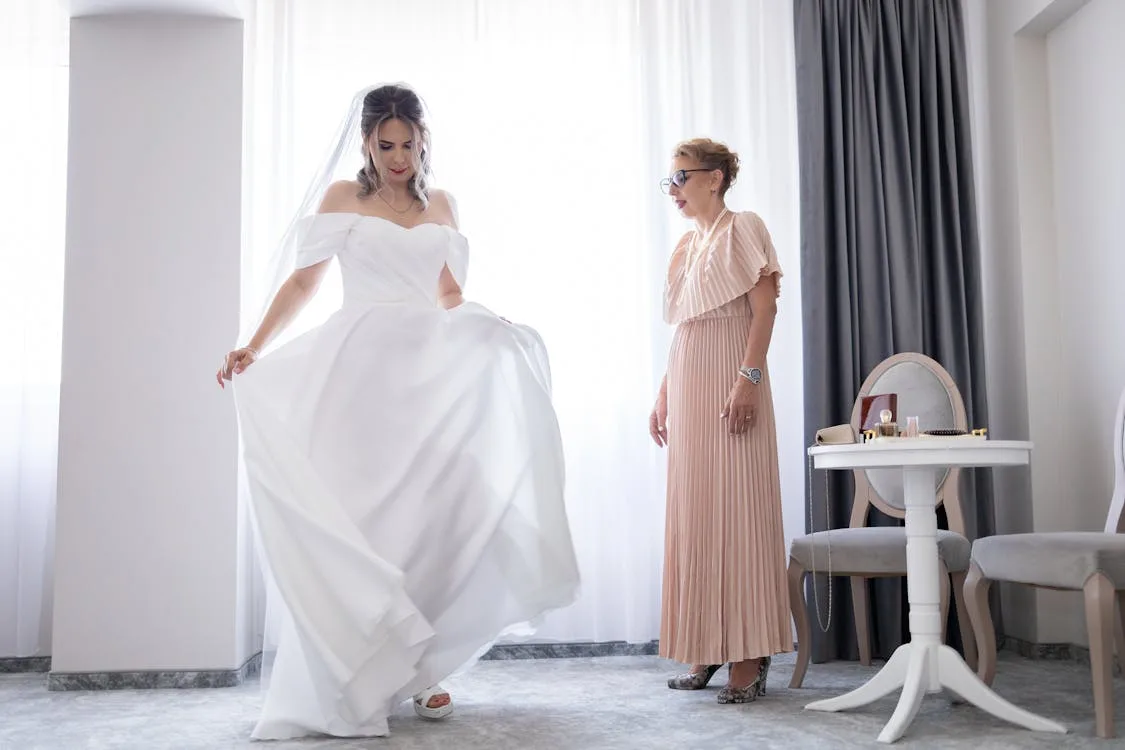
Photo: Jorge Reyes Hernandez / Pexels
Mother of the bride speech examples by relationship
For the daughter who has always known who she is
"[Daughter] has had strong opinions about everything since she was three years old. She knew what she wanted for breakfast. She knew which outfit she was wearing. She knew, at seven, that she was going to be a [whatever it was]. I stopped trying to redirect her around age nine. It turned out that was the right call."
The story"[Specific moment that illustrates this quality — the scene where you saw it most clearly. The decision she made, the thing she insisted on, the way she handled something on her own terms. Tell it in enough detail that the room can see her in it.]"
The turn"I'll be honest with you: I worried sometimes. Not about whether she'd be okay — I never doubted that. I worried she'd choose someone who couldn't keep up. [Groom], I watched you with her for [X] years before today. You don't try to slow her down. You just make sure there's someone beside her when she lands. I'm not sure I could have asked for more than that."
Toast"To [daughter] and [groom] — may you always be exactly who you are, and may you always choose each other anyway."
For the daughter who took the long road
"I thought I knew what I was going to say tonight. I've been writing and rewriting it for six months. What I kept coming back to is this: [daughter] has always been someone who doesn't do anything the easy way. Not because she makes it hard on herself — because she's never been willing to settle for something that isn't real."
The story"[One specific moment that shows her character during a difficult stretch — not the struggle itself, but what she did with it. The decision she made. The thing that told you who she was even when she wasn't sure herself.]"
The turn"I want to say something tonight that I don't think I've ever said as clearly as I should have: I am proud of how you got here. Not just of who you are today — of the path you took to get here, every single step of it. [Groom], you got the full version of her. Take good care of it."
For the speech that leads with welcome to the groom
"I want to tell you something about [daughter] that I've never told her directly. [Lead with a quality about her — something you observed over the years that she may not know you noticed. Something specific, something warm, something true.]"
The welcome"[Groom], the first time I spent any real time with you, I noticed [specific observation — how he was with her, a moment you saw, something small that told you something big]. Parents spend a lot of time watching and not saying anything. I want to stop doing that. You are the right person for my daughter. I've known it for a while and I should have said it sooner."
Toast"To [daughter] and [groom] — welcome to our family. We're not always easy, but we're always yours."
For the short mother of the bride speech
"I've been trying to figure out what to say tonight for longer than I'd like to admit. Every version I wrote felt like it was trying to cover too much.
So here's what I actually want to say:
[Daughter], I have watched you become yourself for [X] years. There were years when I wasn't sure what you were becoming, and years when I could see it clearly, and years when I just had to trust that you knew something I didn't. You always did.
[Groom], I want to say something to you directly and I'm going to say it simply: take good care of her. Not in the way people mean when they say that — not the protective version. I mean: keep seeing her. Keep choosing her. Keep showing up the way you have. That's all I'm asking.
Please raise your glasses. To [daughter] and [groom] — may you always look at each other the way you're looking at each other tonight."

Photo: ByLukeMiller / Pexels
Mother of the bride speech examples by tone
Funny mother of the bride speech examples
"[Daughter] asked me to keep this short. She also asked me not to tell the story about [specific thing]. I'm going to honor one of those requests."
The funny storyThe best funny material in a MOB speech usually lives in the specific texture of your actual relationship — the pattern, the habit, the running disagreement that finally resolved itself. "[Daughter] and I have been negotiating about [something specific] since she was about fourteen. I think today we finally found the terms we can both live with."
The turn"Here's what I haven't said yet. [One honest, specific, genuine thing about her — the quality the humor was pointing at all along.] [Groom], you already know this. That's how I know you're the right person."
Heartfelt mother of the bride speech examples
"I'm not going to try to make anyone laugh tonight. What I have to say doesn't need the cushion."
The story"[Specific scene — a moment from her childhood or adolescence that tells the room something true about who she is. Not the most dramatic thing. The most revealing thing. The moment you think of when you think of her at her most herself.]"
The declaration"[Daughter], I have watched you grow into someone I genuinely admire. That's a strange thing for a mother to say — we're supposed to love unconditionally, and I do. But tonight I want to say something beyond that: you have become someone I would choose to know. I'm very proud of who you are."
Toast"To [daughter] and [groom] — a long and honest life together. Please raise your glasses."
Short and simple mother of the bride speech examples
1. One observation about your daughter — specific, honest, a quality you've watched develop
2. One moment that illustrates it — quick, visual, doesn't need much setup
3. One genuine thing about the groom — not a list, just one thing
4. The toast — two sentences

Photo: Kampus / Pexels
The structure behind every strong mother of the bride wedding speech
Every example above — across different relationships and tones — follows the same logic. Not a formula, but a sequence of moves that the best mother of the bride speeches all make.
1. Open with something specific, not something ceremonial. Not "It's such an honor to be here celebrating [daughter] and [groom]" — that's a weather report. Open with a story, a specific observation, a line that immediately tells the room something real. You've raised this person. You have more material than anyone else at this wedding. Start with it.
2. One story. The right one. Not the highlight reel. Not the most dramatic moment. The story that is most her — the scene that reveals who she is in a way that's specific enough that only you could tell it. If the story could be about any daughter at any wedding, find a different story.
3. The emotional turn. This is the most important moment in any mother to bride speech. It's where the setup — whether funny or warm or wistful — arrives somewhere honest. Not announced ("but in all seriousness..."), just arrived at. The turn usually looks like: here's what I've seen, here's what I know, here's what I want to say while I have a microphone and the whole room listening.
4. Something real about the groom. Not performed. Not the list of his good qualities. One thing you've actually noticed — how he is with her, what you've seen in the way they move through a room together, a moment that told you something. One honest observation from someone who was watching carefully. That's worth more than a paragraph of general praise.
5. The toast. Two sentences. The speech is where you say everything. The toast is the seal. Raise your glass, say something true, let the room drink.
Most mother of the bride speeches that don't land fail at the turn — they stay warm and general the whole way through, never arriving somewhere specific and true. The setup is fine. The stories are sweet. But there's no moment where the room catches its breath. That moment is the job.
What to avoid in the mother of the bride speech
- "I am so honored and proud to be standing here today celebrating..."
- "[Daughter], from the moment you were born, you have been..."
- "I've known this day was coming since [daughter] was just a little girl..."
- "I don't know how to put into words what this day means to me..."
- "On behalf of [family names], I'd like to welcome everyone..."
The adjective catalog. "She is kind, generous, strong, fiercely loyal, endlessly patient, and the most wonderful mother and daughter and friend..." This is adjective stacking — it sounds like praise but contains no information. The room already knows you love her. What they're waiting for is the specific thing that makes her her. Trade ten adjectives for one story.
The running timeline. A speech organized around chronology — childhood, teenage years, college, meeting the groom, now — usually runs too long and has no center. Chronology is a filing system, not a speech. Pick the moment. Tell the story. Let the rest go.
Going over 5 minutes. Most mother of the bride speeches that run long do so because the speaker is afraid of leaving things out. The constraint is a gift: it forces you to find the thing you most need to say. A sharp 3-minute speech that the room will quote at brunch tomorrow beats a thorough 7-minute speech that loses them halfway through.
Write your mother of the bride speech in minutes.
Tell us about your daughter, your relationship, and the groom she chose. We'll write something specific, honest, and exactly right for tonight. Free preview — no card required.
Write My Mother of the Bride Speech → Preview the opening for free · $34 to unlock the full speechFrequently asked questions
Stop reading examples. Write yours.
You have twenty or thirty years of knowing her. That's more material than anyone else at this wedding. Start with the one story only you could tell — we'll help you build it into something she'll carry with her.
Get My Mother of the Bride Speech Written →