What Are Wedding Vows? Meaning, Types and Examples
Planning a ceremony raises a simple question that nobody quite answers: what are wedding vows, and what are you supposed to say? The short version is that they're the promises two people make to each other during the ceremony, spoken out loud in front of the people they love.
Everything else is a matter of style. Some vows are formal and fixed, handed to you by an officiant or a tradition. Others are written from scratch and sound like a love letter read aloud. Both count, and both do the same job, which is turning "we're together" into "we've promised."
This guide explains what vows are, where they fall in the ceremony, the main types, and what goes into them. You'll also get a basic template and a few ways to start. When you're ready to draft your own, our guide on <a href="/blog/how-to-write-wedding-vows">how to write wedding vows</a> takes you through it step by step.
In this guide

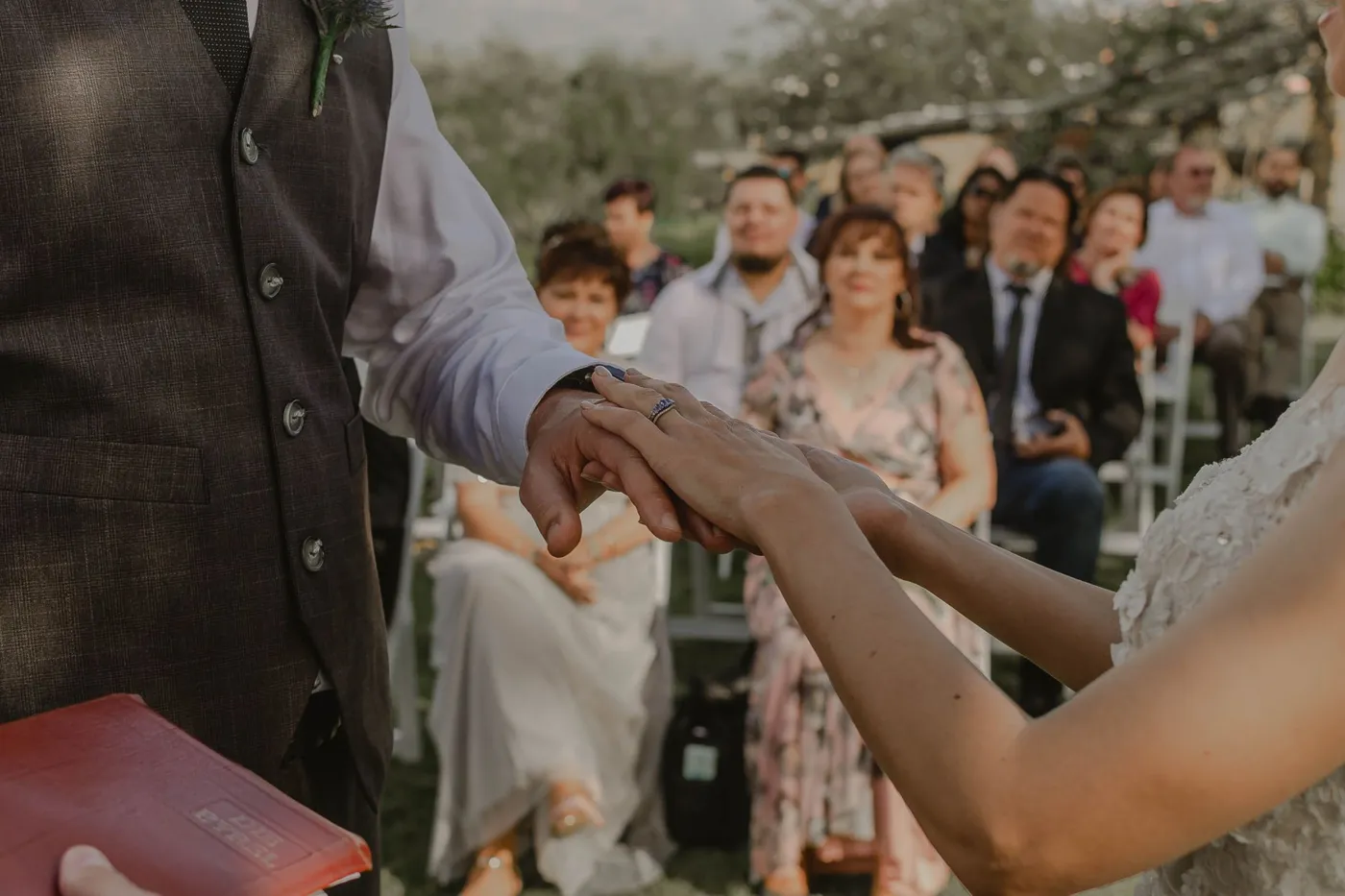
Photo: MELQUIZEDEQUE ALMEIDA / Pexels
What are wedding vows?
Wedding vows are the promises a couple makes to each other during the wedding ceremony. That's the whole definition. You say them out loud, usually facing each other, with your guests and your officiant as witnesses.
If you've ever searched "what are vows" and gotten answers about religion, law and poetry all at once, here's the uncluttered version. A vow is a serious promise. A wedding vow is a promise about how you'll treat the person you're marrying for the rest of your life. It can be a single sentence or a full minute or two of speaking. It can be written by you, written by a tradition, or a mix of both.
Most vows do two jobs at once:
- They state your intention. You say that you're choosing this person and choosing marriage.
- They make promises. You name what you'll actually do: love them, support them, stay, be honest, show up.
Many ceremonies also include an "I do" moment, where the officiant asks whether you take this person as your spouse. It's closely related to vows, but it isn't quite the same thing. The vows are the part where you speak the promises yourself.
One practical note. Legal requirements for a marriage ceremony differ depending on where you live, and in many places the official wording is separate from the vows you choose. Ask your officiant what's required where you're getting married, then treat everything beyond that as yours to shape.
What are wedding vows meant to do?
A wedding is the one time most people make a promise to their partner in front of everyone they care about. That's the point. Vows do a few things at once.
- They make the commitment real. Thinking "I'll stay" and saying it to someone's face are different acts. Saying it out loud, with witnesses, gives the words weight.
- They tell your guests what the marriage is built on. Everyone watching hears what the two of you value, in your own terms.
- They give you something to return to. Plenty of couples keep a copy of their vows. On a hard Tuesday five years from now, it's a reminder of what you meant.
- They anchor the ceremony. The music, the processional and the readings all build toward this moment.
Vows aren't a performance, and nobody is grading them. Guests aren't listening for clever phrasing. They're watching two people mean something. That's why plain, honest sentences are usually the ones people remember.
Where wedding ceremony vows fit in the day
Vows sit near the middle of most ceremonies, after the welcome and any readings, and right before the rings. The exact order depends on your officiant and your tradition, but a typical ceremony runs like this:
- Processional. The wedding party and then the couple make their entrance.
- Welcome and opening words. The officiant greets guests and sets the tone.
- Readings or a short talk. A friend or family member might read a poem or passage.
- Vows. The couple makes their promises, one after the other.
- Ring exchange. The rings are given as a symbol of those promises.
- Pronouncement and kiss. The officiant declares you married.
Some couples put the rings first, or say their vows privately before the ceremony, such as during a first look. Both are fine. There's also no rule about who goes first. Couples often just decide beforehand, or let the officiant pick.
As for how you deliver them, reading from a card is completely normal. Nobody expects you to memorize your vows while your heart is pounding. Print them in a larger font, bring a backup copy, and ask your officiant to hold one too.

Photo: Kawê Rodrigues / Pexels
The main types of wedding vows
Vows come in a few forms, and most couples land in one of four. None is more correct than the others. Choose based on your ceremony, how comfortable you are speaking in front of people, and how much of yourselves you want in the words. For more on the meaning behind each style, see our post on marriage vows for wedding ceremonies, which covers templates and ideas.
Traditional vows
These are the fixed, formal promises many people picture first, with lines like "to have and to hold" and "in sickness and in health." Many religious and cultural traditions have their own set wording, and your officiant or faith leader will usually supply it.
I, [name], take you, [name], to be my spouse. To have and to hold from this day forward, for better, for worse, for richer, for poorer, in sickness and in health, to love and to cherish, until death parts us.
Why it works: It's short, familiar and rhythmic. Guests recognize it, which gives the moment a sense of ceremony. The only downside is that it could be said by anyone, so some couples add a personal line.
Repeat-after-me vows
The officiant says a short phrase and you repeat it. This is a great option if you're nervous, if you don't want to memorize anything, or if you'd rather keep the focus on each other than on a page.
Officiant: Repeat after me. I, [name], choose you, [name].
I promise to love you honestly.
To stand beside you in good times and hard ones.
And to keep choosing you, every day.
Why it works: There's no pressure to remember a script, and the short lines give each promise room to land.
Personal vows
Written by you and spoken directly to your partner. This is what most people mean today when they talk about personal wedding vows. They can run from thirty seconds to two minutes, and they sound like you instead of a script. Most of the rest of this guide is about this type.
A blend of both
Many couples say a short traditional vow to make it official, then follow it with a personal promise. You get the weight of the familiar words and the warmth of your own. If you can't decide between the two, this is usually the easiest compromise.
What goes into personal wedding vows
Personal wedding vows are the most flexible kind, which is both the appeal and the difficulty. Writing wedding vows from nothing is hard because no rule tells you where to begin. A reliable structure helps. Most strong vows contain these pieces, in roughly this order:
- An opening that speaks to them. Use their name and say something direct.
- One specific memory or observation. A real moment, like the night they drove across town with soup when you had the flu, tells guests more than "you're so kind" ever could.
- Three or four promises. Concrete things you'll do, in ordinary language.
- A look ahead. One line about the life you're starting.
- A short, plain close. "I love you" still works.
Aim for one to two minutes spoken, which is roughly 150 to 200 words. That feels short on paper and long when you're standing in front of everyone.
The best wedding vows tend to share a few habits. They use details only the two of you would know, they sound like how you talk, and they make promises you actually intend to keep. Skip lines that could be printed on a greeting card. Skip inside jokes unless you explain them in a sentence. And skip promises nobody can keep, like "I'll never be angry with you." Real promises leave room for being human.
Tone is yours to choose. Funny, tender, formal or a bit of each all work, as long as the ending is sincere. If you want to see how tone changes the same structure, our post with ten full wedding vows examples shows traditional, modern, short and funny side by side.
Basic wedding vows and a simple template
If you need somewhere to start, a wedding vows template gives you the skeleton. Basic wedding vows follow the same shape almost every time: say what this person is to you, make your promises, and close warmly. Fill in the brackets with your own details.
[Name], when I think about us, I think about [a specific memory or habit]. That's when I knew [what you realized].
I promise to [a promise about everyday life]. I promise to [a promise about hard times]. I promise to [a promise that's just about the two of you].
I can't wait for [something you're looking forward to]. I love you, and I choose you, today and every day.
Here's the same wedding vow template filled in, so you can see how little it takes:
[Name], when I think about us, I think about Sunday mornings with the crossword and too much coffee. That's when I knew I'd found my person: someone I could be quiet with and still feel completely understood.
I promise to make the coffee, even on the mornings you say you don't want any. I promise to stay calm and kind when things get hard, and to tell you the truth when it's awkward. I promise to keep laughing at your terrible puns.
I can't wait for all the Sundays we haven't had yet. I love you, and I choose you, today and every day.
Why it works: It opens with a real picture instead of an adjective. The promises are small enough to believe, and the close is short enough to say without your voice cracking halfway through. Copy the shape, but replace every detail with your own.

Photo: Dan Parlante / Pexels
How to start wedding vows
The first line is where most people freeze. The good news is that there are only a handful of ways to open, and any of them works. Pick the one that feels most natural.
- Start with their name and a direct statement. "[Name], I didn't expect to meet my best friend at a barbecue, but here we are."
- Start with a memory. "The first time you made me laugh so hard I forgot where I was, I knew."
- Start with what they've given you. "You made me feel at home in a place I'd never been."
- Start with a simple truth. "I've tried to figure out how to say this for weeks, and the honest version is that I'm happy."
- Start with the moment itself. "Standing here, in front of everyone we love, all I can see is you."
Here's a trick that helps: write the opening last. Once the promises are down, you'll know what the vow is really about, and the first line becomes much easier. Also, skip the dictionary definition or the famous quote. Guests have heard those, and your own sentence will always land better.
Plenty of wedding vow ideas come from the same place, which is your own camera roll, your text history and the stories your friends tell about you. Skim those for ten minutes before you write, and the first line tends to show up on its own.
Wedding vows aren't the same as a wedding speech
This is where a lot of couples get tangled up. Vows and speeches both involve saying heartfelt things into a quiet room, but they're different jobs.
- Vows are spoken to your partner during the ceremony. They're promises, they're short, and they feel private even with an audience.
- Wedding speeches and toasts are given at the reception, to the whole room. They thank people, tell stories, get a few laughs and usually run three to five minutes.
Plenty of people give both. Grooms and brides often say a few words at the reception, and so do best men, maids of honor and parents. If that's you, you're writing two very different things in the same few weeks.
Your vows should be yours. They're a promise to one person, and nobody else should put those words in your mouth. The reception speech is a different story. It means holding a room's attention, thanking the right people without forgetting anyone, and finding the right balance of funny and sincere. That's the part many people put off until the last week, then stare at a blank page.
That's what we're for. Tell us about your partner, your story and the people in the room, and we'll write a speech built from your details instead of a generic one. You'll see the opening for free before you decide, and it takes minutes, not evenings.
Write your own vows. We'll write your wedding speech.
Your vows are a private promise, and they should come from you. The reception speech is a different job: thanking everyone, telling your story and speaking to the whole room. Answer a few questions about your partner and we'll write a personalized speech in minutes, so you're not facing a blank page the night before.
Write My Wedding Speech → Preview the opening for free · $34 to unlock the full speechFrequently asked questions
Vows you write. A speech we can write for you.
Now you know what vows are and how to start yours. If you're also giving a speech at the reception as the groom, the bride or anyone else in the wedding, that's the one most people dread. Tell us about your partner and your story, and we'll write a personalized speech in minutes.
Write My Speech →