Best Man Speech Template: A Fill-In Structure That Works
Most advice about writing a best man speech tells you to "speak from the heart" and "be authentic." This is the most useless advice in the history of wedding preparation. The heart knows how it feels. It does not know how to structure a five-minute narrative with a beginning, a story, and a genuine turn before the toast. That's a writing problem — and writing problems need a structure.
This page gives you the actual template. Fill-in slots for each section, guidance on what each one needs to do, and a completed example so you can see what it looks like when it's done.
The template handles the architecture. You still have to bring the story — the specific, particular thing that only you could tell about this person. That part can't be templated. But once you have it, everything else fits into a structure that works every time.
In this guide
The best man speech template
This is the four-part structure used in virtually every best man speech that works. Copy it, fill in the bracketed sections with your own material, and read it aloud three times before the wedding.
Drop into something specific. Do not open with your name or how long you've known him — the couple just introduced you. The first line earns attention or it doesn't.
[A line that immediately establishes who he is or what your friendship is — told as observation or the start of something, not as introduction. E.g.: "I've known [groom] for [X] years. In that time, I've watched him do a lot of things I'm specifically not going to talk about tonight — he knows which ones — but I do want to tell you one thing that I think explains everything."]
Part 2 — The Story (90 seconds / ~195 words)One scene. Specific enough that only you could tell it. Revealing enough that the room sees who he actually is.
[Set the context briefly — his age, where you were, what was happening. One sentence.]
[What happened — the specific thing he did or said. Two to three sentences. The more concrete the detail, the harder it lands.]
[What you took from it — optional. One sentence if you include it. The story should mostly speak for itself.]
Part 3 — The Turn (45–60 seconds / ~100–130 words)This is the pivot from warmth or humor toward something honest. It arrives — don't announce it. No "but in all seriousness." Just let the tone shift.
[The thing you've been building toward. The honest observation, plainly stated. What you actually wanted to say when you agreed to give this speech.]
[One sentence directly to the bride or to both of them. Something specific, not a sentiment. What you've noticed. What you've watched.]
Part 4 — The Toast (30 seconds / ~65 words)Two sentences. Specific to them. Raise your glass and stop.
"To [groom] and [bride] — [one specific, personal wish. Not 'may you always be happy.' Something only you would say about these two people.]"
"Ladies and gentlemen, please raise your glasses."
That structure runs 3–4 minutes. Every part has a job. When a best man speech fails, it almost always fails in Part 1 (bad opener), Part 2 (wrong story or no story), or Part 3 (the turn is announced instead of earned, or never arrives at all).
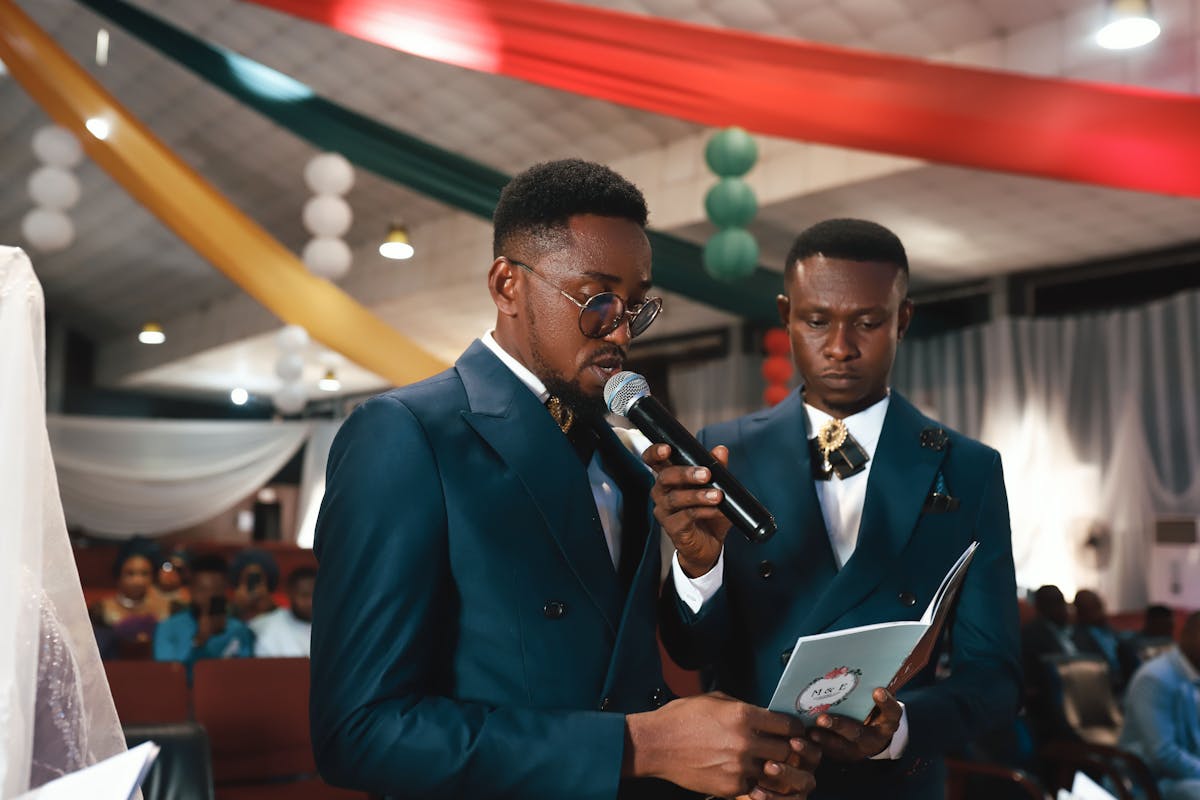
Photo: Evlogia Pictures / Pexels
What each section of the template needs to do
Part 1: The opener
The opener's job is to earn the room's attention before it drifts — and it starts drifting after about twenty seconds if nothing has happened yet.
The most common opener in wedding speeches is: "Hi everyone, for those who don't know me, I'm [name], and I've known [groom] for [X] years." Somewhere between forty and sixty percent of best man speeches open with a version of this line. The room's attention peaks the moment you're introduced, then sinks as you fill it in with logistics.
The alternative isn't clever or performative — it's just to start. Drop into the thing itself. If you're opening with a story, start in the middle of the scene. If you're opening with an observation, lead with the observation. Everything else — your name, how you know him, how long you've been friends — comes out naturally within the first sixty seconds without any announcement.
What works: A line that's immediately specific. Something the room couldn't have predicted. An observation that signals you actually know this person rather than know about him.
What doesn't: Your name, your job title, "for those who don't know me," "I've been asked to say a few words," or any apology for giving a speech.
Part 2: The story
This is the only irreplaceable part. Everything else in the template can be adapted, shortened, or adjusted. The story can't be borrowed from somewhere else.
The right story has three qualities: it's specific (only you could tell it), it's self-explanatory (doesn't require forty-five seconds of setup before it gets interesting), and it reveals his character rather than just recounting what happened.
The wrong stories are the ones that make up most online best man speech examples. Here's how to recognize the wrong story: after you read it, you could swap the groom's name for another person's name and nothing would change. "He's always been there for me." "He works harder than anyone I know." "He never gives up." These are tributes to a concept, not to a person. They land like a list — the room applauds because it's over, not because anything stuck.
The story that works is the one where a specific detail reveals something general and true. Not "he's loyal" — the scene where he drove four hours in the wrong direction because you called and sounded like you needed it, and he showed up and didn't mention it. The detail does the work. You don't have to name the quality at the end.
Length: 90 seconds delivered, roughly 195 words written. If your story is running past two minutes, one of two things is true: you have two stories and haven't picked one, or you have too much setup before the scene starts. Cut from the beginning, not the end.
Part 3: The turn
The turn is the most important moment in the speech and the one almost nobody thinks to plan for. It's the point where the humor or warmth you've built gives way to something honest — the thing you actually came here to say.
Most people treat humor and emotion as two separate modes and switch between them by announcing the switch. "But in all seriousness..." is the announcement. The problem is that announcing the turn breaks the spell. The room shifts from being with you emotionally to watching you shift modes.
The version that works doesn't announce anything — it just changes tone. The story is still present. The honest observation arrives as a consequence of what just happened, not as a gear change. The room feels the shift before they know it's happening, and that's when the room goes quiet in the way that matters.
The turn doesn't need to be long. One or two sentences, plainly stated, is often more powerful than a paragraph. "I've known him for fifteen years and I've never once seen him do anything halfway. This isn't different." That's a turn. It's specific, it's earned, and it doesn't reach.
One rule: the turn should say something you mean. Not something that sounds like what a best man should say — something you'd say if the room wasn't there. The room can tell the difference.
Part 4: The toast
The toast is not more speech. It's the seal.
Two sentences. Specific to them. Raise your glass. Stop there.
The speech is where you say everything. The toast is the period at the end of the sentence. Extending the toast — adding another observation, a second wish, a callback to something from earlier — turns it from a seal into an addendum. The room is ready to drink. Let them drink.
What makes a toast specific: it couldn't have been said about a different couple. "May you always be happy" is not specific. "To [groom] and [bride] — may you always have someone willing to tell you when you're wrong, and the sense to listen" is specific if it's earned by what came before it. "To the two of you — may the next chapter be as good as watching this one begin" is specific if the speech set that up.
If nothing specific comes to mind, a plain toast is better than a generic one dressed up to sound personal. "To [names] — the next part starts now. Please raise your glasses." That works.

Photo: Engin Akyurt / Pexels
The template filled in — a complete example
Here's the template above with all four parts filled in. This is a fictional example built to show the structure working — not a speech to copy, but a demonstration of what it looks like when each section does its job.
"I've been [groom]'s best friend for twelve years. In that time, I've watched him make a lot of decisions I wasn't sure about. He knows which ones. I was wrong about some of them. Tonight, I want to talk about the one time he was completely, obviously, embarrassingly right from the start — and I took about eighteen months to catch up."
Part 2 — The story"About three years ago, [groom] came back from a first date and called me at midnight. He said three things: she's funny, she reads actual books, and she told me I was wrong about something within the first hour and she was correct. I told him that sounded exhausting. He said that was the point."
"I filed that away and didn't think much of it. Then I watched what happened over the next year. The way he started paying attention differently. The way he'd come back from weekends and be — I don't know — quieter, but in a better way. Like something that had been running at the wrong setting had found the right one."
Part 3 — The turn"I've been thinking about what to say tonight for a long time. What I keep coming back to is this: the best thing I can tell you about [groom] is the thing he's always been, which is that when he decides something matters, he stops doing anything halfway. For twelve years I watched him apply that to everything except the things that were most worth it. [Bride], I think you already know what I mean. The rest of us are just glad he figured it out."
Part 4 — Toast"To [groom] and [bride] — may every year give you more to argue about, and may you always be right."
"Ladies and gentlemen, please raise your glasses."
That speech runs just under four minutes at a normal delivery pace. It has one story. The opener earns attention without introducing anyone. The turn arrives without announcement. The toast is specific enough that it could only belong to this couple.
Notice what's not there: a thank-you list, a timeline of the relationship, a quote from a card, a second story as backup, or a line that starts with "but in all seriousness." None of those are in the template because none of them are needed.
The short best man speech template (under 3 minutes)
If you want to keep it under three minutes — either because the couple asked you to, or because you know your strongest material is tight — here's the condensed version.
The structure is the same. The difference is compression: the story runs 60 seconds instead of 90, and the turn runs 30 seconds instead of 45.
"[Opener — one line that drops directly into something specific. No setup.]"
"[Story — 3–4 sentences. Context, what happened, one concrete detail. Stop there. Don't explain what it means.]"
"[Turn — one or two sentences. The plain, honest thing. No preamble.]"
"[One sentence for the bride/couple — what you've noticed, what you're glad about.]"
"To [names] — [specific toast, one sentence]. Please raise your glasses."
A short speech isn't a lesser speech — it's a more disciplined one. The constraint forces you to find the one story and tell it completely, rather than filling the time with context and qualifications. Most best man speeches that run over five minutes would have been stronger at three.
The speeches that fail aren't bad because they're short. They fail because the speaker kept going past the natural ending — the moment when the story was done and the toast should have followed. The template's short version just makes that ending explicit: story, turn, toast, sit down.
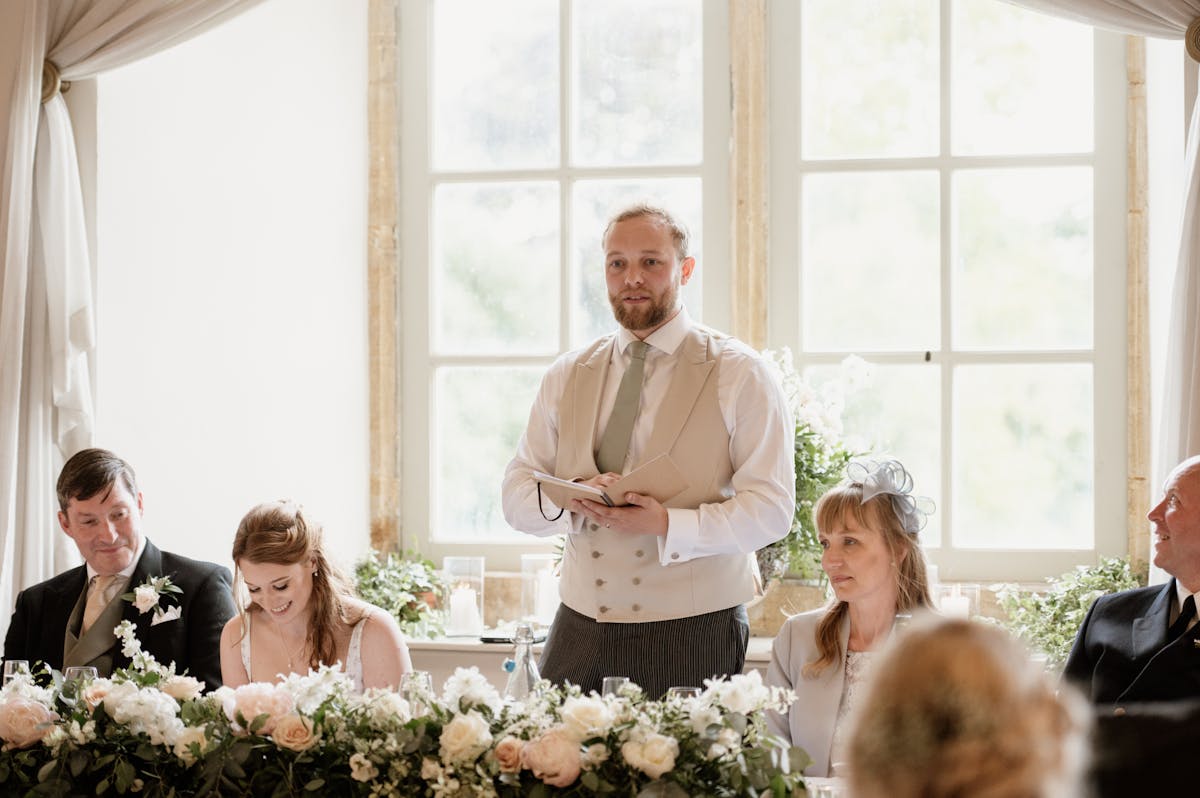
Photo: Pexels User / Pexels
What the template can't do for you
The template handles the structure. It can't find the story.
The most common problem in best man speeches isn't structure — it's specificity. Speeches that fail almost always fail because every sentence in them could have been said by anyone about anyone. "He's one of the most loyal people I know." "She brings out the best in him." "I've never seen him this happy." These lines aren't wrong. They're just empty — generic enough that the room can't hold onto them.
The thing that makes a speech work is the detail that couldn't have been written for a different person. The specific wrong thing he said at the exact wrong moment. The version of himself he was when he thought no one was paying attention. The scene from two years ago that you haven't told anyone, that explains something true about who he is.
That's the story the template is waiting for. Once you have it — really have it, written down in plain sentences without trying to make it speech-ready yet — the template tells you exactly where to put it and what needs to come before and after.
The process that works: write the story first, in your own words, the way you'd tell it to a friend. Don't start with the outline. Don't start with the opener. Start with the scene. Then bring the template to it.
Turn your story into a finished best man speech.
Tell us what you know — the stories, the relationship, the things you've been trying to put into words. We'll build the speech around your material using this exact structure. Free preview, no card required.
Write My Best Man Speech → Preview the opening for free · $34 to unlock the full speechFrequently asked questions
The structure is here. Now you just need the story.
Tell us what you know about him — we'll build the speech around it using this exact framework. Most people finish in under fifteen minutes.
Build My Best Man Speech →